AKC is a participant in affiliate advertising programs designed to provide a means for sites to earn advertising fees by advertising and linking to akc.org. If you purchase a product through this article, we may receive a portion of the sale.
For all the joy and excitement of bringing home a new puppy, potty training can be one of the biggest challenges new owners face. In fact, one of the most common questions received by The AKC GoodDog Helpline, AKC’s live dog training consultation service, is how to potty train a puppy. While teaching a puppy to eliminate outdoors is the ultimate goal for many owners, puppy pads can be a useful training tool in certain situations. Understanding when and how to use them can help set your puppy up for success.
In This Article
When Puppy Pads Can Help
Puppy pads aren’t necessary for every puppy, but they can be helpful in certain situations. Very young puppies need frequent bathroom breaks and aren’t always physically capable of holding their bladder long enough to make it outdoors every time. Owners living in apartments may also face challenges reaching an outdoor potty area quickly enough.
Some owners choose puppy pads while waiting for their puppy to complete their vaccination series, especially when outdoor potty areas are heavily used by other dogs. Whether you use disposable pads, reusable pads, or an indoor potty station, consistency is essential. Once you choose a potty area, avoid changing locations until your puppy understands exactly where they’re expected to go.
Staying Patient Through the Process
It’s easy to get frustrated with your new puppy when potty training takes longer than expected. But it’s essential to be patient during this process. Puppies do not have full bladder control during the earliest stages of development. Many puppies cannot reliably control their bladder until they’re approximately 16 weeks old.
A useful guideline is that puppies can often hold their bladder for about their age in months, plus one hour. For example, a 4-month-old puppy may be able to hold it for roughly five hours.
Keep in mind:
- Toy breeds often need more frequent potty breaks.
- Individual puppies learn at different rates.
- Some puppies may progress quickly, while others need several months.
Avoid comparing your puppy’s progress to another dog’s timeline.

Maintaining Close Supervision
It’s important to watch your puppy at all times for safety, but this is also the key to successful potty training. You can’t prevent accidents if you don’t have your eyes on the dog. Here are some tips to help with supervision:
- Take your puppy to the potty pad or indoor bathroom frequently. How often will depend on their age and bladder strength. For very young puppies, it could be as often as every 15 minutes. Better a wasted trip than an accident.
- Set a timer if you’re having trouble remembering when to take your puppy to their pad.
- Watch your puppy for telltale signs they have to go, such as sniffing the ground, circling, or whining. When you see those signs, take them straight to the potty pad.
- Use a leash if you have trouble keeping your puppy in sight. Clip the leash to your waist to limit your puppy’s movements.
- Put your puppy in a crate or a safe area whenever you can’t supervise them.
Use a Crate to Prevent Accidents
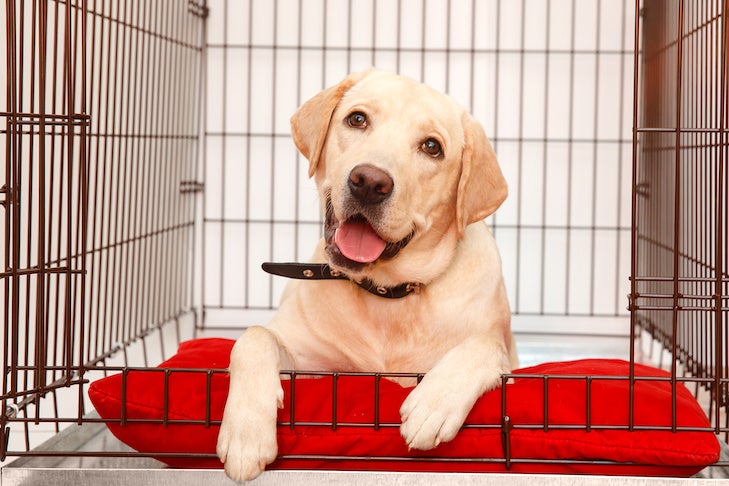
A crate is an important potty training tool because dogs don’t like to soil where they sleep. Plus, a strong denning instinct means that if you introduce a crate properly, your puppy will see it as their safe space rather than a punishment. Keep the following in mind when introducing a crate to your puppy:
- Choose an appropriately sized crate. Your puppy should be able to lie down and turn around but with no extra room. If the crate is too large, your puppy can use one end as a toilet, which will delay potty training.
- Use dividers with a larger crate. If you buy a crate for your dog’s adult size, dividers can help the crate “grow” with your puppy.
- Associate the crate with wonderful things. If you put treats in the crate, feed your puppy at the back of the crate, and leave food-stuffed chew toys in the crate, your puppy will learn to love it.
- Reward your puppy for going in their crate. They’ll be happy to go inside if it’s a rewarding place to be. Although a crate is great for a quiet time out, don’t use it for punishment.
- Take your puppy straight to their potty pad whenever you let them out of the crate.
Create a Consistent Bathroom Routine
When thinking about how to potty train a puppy, don’t underestimate routine and consistency. Setting a schedule and sticking to it will help prevent accidents. Plus, it will ensure you give your puppy every chance to go in the correct location. These tips will help you stay consistent:
- Know when your puppy has to go. Most puppies need the bathroom when they wake up in the morning, after eating, playing, and napping. So, take your puppy to the potty pad every time one of these events occurs.
- Take your puppy to the potty pad anytime they haven’t been for an hour or two
- Bring your puppy to the potty pad whenever you suspect it’s time. But if they don’t go, don’t let them run around and play. Instead, put them back in their crate for 10-15 minutes, then immediately try again. Repeat until they do their business.
- Feed your puppy on a schedule. If you control when your puppy eats, you can better predict when they’ll have to go to the bathroom. Don’t free feed.
- Choose an appropriate place for the potty pad. Try not to move it while your puppy is still learning. If you confuse your puppy, they’ll likely have more accidents and take longer to train.
Reward Successful Potty Trips Immediately
Dogs repeat behaviors that are rewarding, and doing their business in the right spot is no different. If you reward your puppy with praise and treats whenever they use their potty pad, they’ll be more likely to use it again. Keep the following in mind when rewarding your puppy:
- Reward your puppy immediately after they do their business. Don’t wait to get the treats out of the cupboard. Have them ready to go in the moment. You can keep a bowl or bag of treats beside the potty area so you’re always prepared.
- Use a leash if your puppy is easily distracted. Walk them to the potty pad on a leash and only unclip them after they’ve done their business. The freedom to play will be a bonus reward.

Transitioning From Pads to Outdoor Potty Training
When your puppy is ready to begin eliminating outdoors, many of the same training principles still apply. The primary difference is that you will be guiding your puppy to an outdoor location instead of a potty pad. A gradual transition is often the easiest approach.
You can help your puppy succeed by:
- Teaching a potty cue such as “hurry up” or “go potty.” Say the cue just before your puppy eliminates, then reward them immediately after they finish. With enough repetition, you’ll be able to ask your puppy to go where and when it’s convenient for you, including in the outdoor toilet area.
- Moving the potty pad closer to the door in small increments.
- Relocating the pad just outside the door once your puppy is comfortable.
- Gradually moving the pad to the final outdoor bathroom location.
- Reducing the size of the potty pad over time until your puppy is confidently using the ground surface alone.
Many puppies adapt quickly, particularly if they already understand a potty cue and have been consistently rewarded for success.
Responding Calmly to Accidents
It’s human nature to look for what’s wrong and take what’s right for granted. But we need to do the complete opposite with our puppies. Always reward and praise good behavior and ignore the things that go wrong. This is especially true with potty training accidents. Here are some tips for handling potty accidents:
- Interrupt your puppy if you catch them in the act of having an accident. Don’t scare or startle them. Instead, marking the behavior with a quiet hand clap or the words “oh-oh” should be enough to stop them mid-stream. Punishing them in the act will only teach them not to go in front of you, leading to a dog that sneaks behind the couch to go in private.
- Take your puppy to their potty pad as soon as you catch them. If they stop when you interrupt them, they might finish on the pad. If they don’t finish on the pad, at least you’ve shown them where they should’ve gone.
- Don’t react if you learn of an accident after it happened. Lecturing your puppy afterward won’t teach them anything about potty training.
- Clean all accidents with an odor-destroying cleaner. Dogs are attracted to the smell of previous business, so thorough and proper cleaning is essential.
Key Takeaways
- Puppy pad training is most successful when puppies follow a consistent bathroom schedule and always use the same potty location.
- Close supervision helps prevent accidents and allows owners to redirect puppies before they eliminate in the wrong place.
- Crate training can support housebreaking because most puppies naturally avoid soiling their sleeping area.
- Immediate praise and rewards help puppies learn where they are expected to go to the bathroom.
- When transitioning to outdoor potty training, gradually moving the potty area and maintaining routines can reduce confusion and setbacks.
Frequently Asked Questions
-
How often should I take my puppy to a potty pad?
+
Very young puppies may need potty trips as often as every 15 minutes when awake. As puppies mature and develop better bladder control, the time between trips can gradually increase.
-
How do I get my puppy to pee on a pee pad?
+
Take your puppy to the pee pad frequently, especially after eating, sleeping, drinking water, and playing. Reward them immediately with praise or a treat whenever they use the pad successfully.
-
Do puppy training pads really work?
+
Yes. Puppy training pads can be an effective house-training tool for young puppies, apartment dwellers, and owners who cannot take their puppy outside frequently. Consistency and supervision are essential for success.
-
How long does it take to puppy pad train a dog?
+
Most puppies make noticeable progress within a few weeks, but complete potty training can take several months. Age, breed, routine, supervision, and consistency all affect how quickly a puppy learns.
-
Can crate training help with potty pad training?
+
Yes. A properly sized crate helps prevent accidents because most puppies prefer not to soil their sleeping area. Crate training also helps establish a predictable potty routine.
-
How do I transition my puppy from pee pads to going outside?
+
Gradually move the potty pad closer to the door and then outdoors while continuing to reward successful potty trips. Teaching a potty cue and maintaining a consistent routine can help make the transition easier.