Choosing a winner at a dog show is much more complex than selecting the prettiest dog in the ring. Judges evaluate each dog against its breed standard, drawing on years of experience and deep knowledge of purebred dogs. At every level of competition, judges must determine which dogs most closely match their breed’s ideal characteristics and, ultimately, which one deserves to advance.
In This Article
From Breed Competition to Best in Show
Every judge enters the ring with the challenging task: selecting one winner. The pressure only increases on some of the sport’s biggest stages. A judge must choose from an exceptional lineup of dogs, stick to a television schedule, and sometimes even navigate a plush carpet under the spotlight.
“It is a difficult task, but in the end, you have to pick one through four,” Judge Jason Hoke says, recalling his time judging the Toy Group at the Westminster Kennel Club Dog Show.
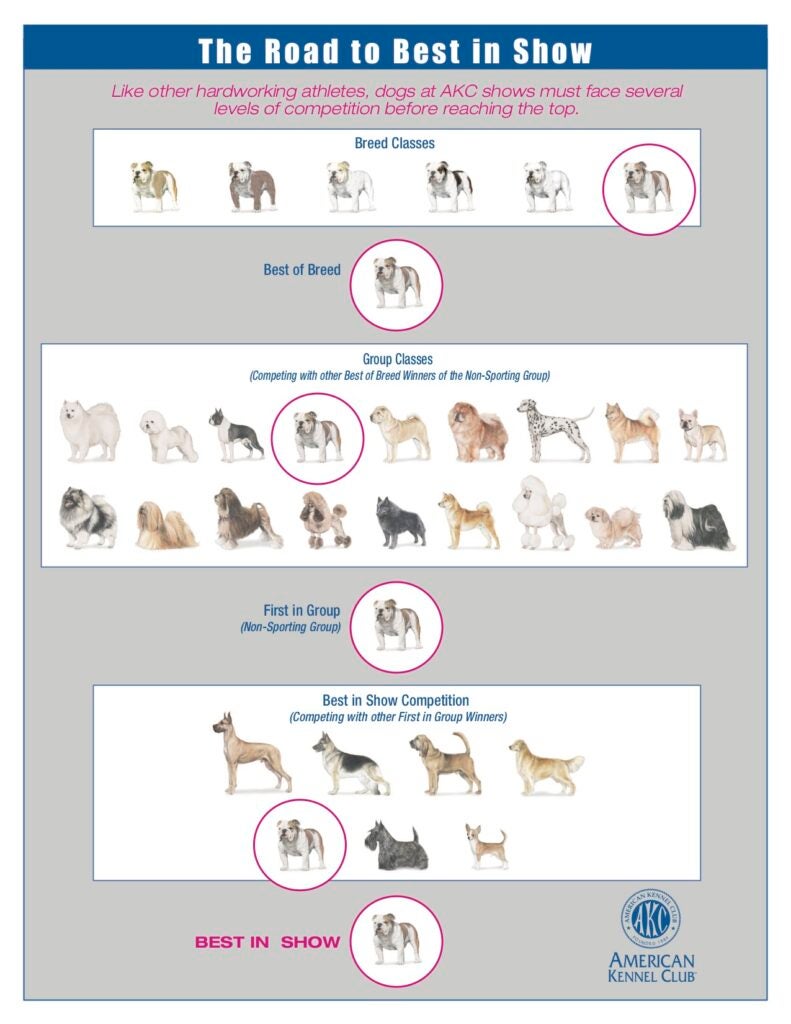
Before a dog can make it to the group level, they must face some serious competition at the breed level. Conformation dog shows are elimination events, so the competition gets tougher with each round.
A dog advances through three stages:
- It wins “Best of Breed” and moves on to face group competition
- It wins the group and moves on to the final round
- It competes for “Best in Show” and “Reserve Best in Show” (second place)
That could mean whittling down thousands of dogs to find one winner.
In the United States, the AKC governs and sanctions conformation dog shows.
Judging Dogs Against Breed Standards
One of the most common misconceptions about conformation shows is that dogs compete directly against one another. In reality, judges evaluate each dog according to its breed’s AKC standard.
Just as a musician strives to play a perfect chord, a dog show judge works to perfect one skill: measuring each dog against its breed standard.
For example, in the Hound Group, a judge doesn’t directly compare the Greyhound with the Afghan Hound. Instead, the judge compares the Greyhound with the Greyhound breed standard and the Afghan with the Afghan standard. The winner is the dog that exemplifies its standard better than the other dogs represent theirs.
This approach helps preserve the traits, structure, movement, temperament, and function that define each breed.

The Education and Preparation Required to Judge
To become an AKC-licensed judge, an individual must complete several educational requirements (exams, seminars, being a mentee) and gain years of experience showing as a handler. Becoming a judge isn’t an easy task. It takes a dedicated person with an insatiable appetite for knowledge and a love of the sport to make the cut.
But just because a judge becomes licensed doesn’t mean the schooling stops. Knowing the breed standards front to back is one thing. Running a ring is quite another.
“We can all judge outside the ring,” Hoke says, “but once you step in the ring, it’s a different story. When you’re outside you can focus on one dog you like. But as a judge, you have two minutes to make your decision.”
Brushing up on breed knowledge ahead of a competition is also essential.
“Every judge worth their salt does a review of breed standards before a judging assignment,” says Virginia Lyne, an all-breed judge. “I always remind myself of the disqualifications applicable to breeds I will be judging that day.”
In addition to breed knowledge, judges must manage the pace of competition, maintain order in the ring, communicate clearly with exhibitors, and make accurate decisions under pressure.
Visualizing the Picture-Perfect Dog
Great dogs can easily stand out to judges, but what happens when the ring is full of exceptional canines? Seasoned judges evaluate every dog that comes before them. No matter how experienced they are, judges are still human, and judging isn’t automated.
“I wish exhibitors would realize that judges, by and large, want to judge to the best of their ability, to find the right dog, and never, never miss a great one,” Lyne adds. “I think people are inclined to look for explanations totally removed from the real process of evaluating breeding stock, thoughts about who likes who, who was wearing the judge’s favorite color, the list goes on and on.”
It can be hard for the public to understand that dogs aren’t necessarily being judged against each other. Instead, they’re being judged individually as dogs that can carry on the best of their breed’s characteristics to the next generation. A judge’s thought process can easily be related to their own breeding programs.
“I always have to ask myself: which one would I use in a breeding program?” explains Elliott B. Weiss. He became a judge in the early ’90s after many years as a successful professional handler.
“What I think is hard for the public to understand is that you’re not judging the dogs against each other,” he says. “You’re judging the dogs against a picture of perfection you have in your mind of the standard.”

Why Conformation Judging Is About More Than Appearance
To the untrained eye, a conformation dog show can seem like a beauty pageant, but purebred enthusiasts will tell you there’s more to it.
At its simplest, a dog show is where judges evaluate dogs for breeding programs. Judges’ decisions in the ring influence how handlers present their dogs and how breeders plan the next generations of their breed.
People developed each breed for a specific purpose. For example, they bred many Toy breeds to be lap dogs and hounds to help humans hunt wild game. These functions formed each breed’s “standard,” a blueprint for how the breed should look and act.
“While judging is about beauty, it is about beauty defined within a breed and about how a breed became what they are and how they look to the judge on that day,” Hoke says. “There’s a lot of history involved about why certain beauty exists in each breed. History dictates what a breed is, and what it looks like.”
“I’ve judged overseas, and it’s nice because you get to see the breeds in their countries of origin,” he adds. “When they say ‘high, mountainous terrain,’ you see what that terrain is and why (the breeds) were built that way.”
A good judge will not only see a dog’s appearance, but their breed personality, as well. A dog that displays its breed’s true temperament can stand out, especially at larger shows.
The AKC National Championship, presented by Royal Canin, is coming to your screens soon! Stay tuned for broadcast information, and in the meantime, check out last year’s 2025 Best in Show winner! Learn more about conformation and follow your favorite breeds at dog shows throughout the year.