AKC is a participant in affiliate advertising programs designed to provide a means for sites to earn advertising fees by advertising and linking to akc.org. If you purchase a product through this article, we may receive a portion of the sale.
The Cocker Spaniel is one of the AKC’s most popular breeds. But did you know there is another Cocker Spaniel breed? That’s right, the Sporting Group also contains the English Cocker Spaniel. To add to the confusion, outside the United States, the English Cocker Spaniel is known simply as the Cocker Spaniel, while the American breed is often called the American Cocker Spaniel.
To avoid any mix-ups, let’s compare the American and English Cocker Spaniels.
How the Two Breeds Developed
Both the American and English Cocker Spaniels trace their roots to the spaniels of centuries past. Spaniels were traditionally divided into land spaniels and water spaniels according to where they worked. By the 1800s, land spaniels were also grouped by size.
According to Chereen Nawrocki, breeder and past president of the English Cocker Spaniel Club of America, “In one litter you could have dogs considered any of the various land spaniel types — springers, fields, cockers, or toys — depending on their adult weight.”
Diane Kepley, breeder, judge, and former president of the American Spaniel Club, explains that larger puppies were called field spaniels and springer spaniels, while the smaller dogs were the cockers. The latter’s name came from the woodcock, a game bird commonly hunted with these compact sporting dogs.
“Cockers have traditionally been used to hunt in deep cover, shrubs, and other heavy vegetation, because of their small size,” says Kepley.
As breeders began selecting specifically for springers or cockers, and the two groups diverged. Breeders in the United States and Great Britain emphasized different qualities. According to Nawrocki, “Most American breeders concentrated on the smaller, elegant solid Cockers blended with the smaller Field Spaniels. While the British breeders were breeding roan and parti-colored springer types with their Cocker Spaniels to produce a larger, leggier Cocker who would hunt and retrieve.”
Although the two types were originally considered the same breed, the American Kennel Club recognized the English type as a separate variety in 1936. In 1946, the English Cocker Spaniel was officially granted separate breed status.
-

- English Cocker Spaniel

-
- Cocker Spaniel

Physical Characteristics and Appearance
Despite their shared heritage, the American and English Cocker Spaniels are easy to distinguish once you know what to look for.
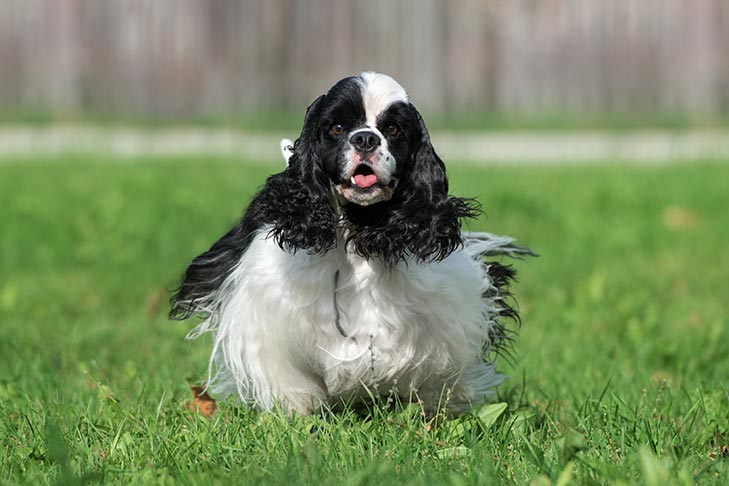
The Cocker Spaniel is the AKC’s smallest sporting breed. Standing 13.5 to 15.5 inches tall and weighing 20 to 30 pounds, they have a compact, sturdy body and a flowing coat that comes in a variety of colors and patterns.
The English Cocker Spaniel stands 15 to 17 inches tall and weighs 26 to 34 pounds. Their body is more squarely built, with greater leg length and an overall sportier appearance. Roan coat patterns are particularly common in the breed.
Coat presentation is another notable difference. Kepley says, “While both breeds have the same coat texture, Cocker Spaniel fanciers have selectively bred for more coat. In Cocker Spaniels, the length of hair is pronounced on the legs and sides.”
Head shape is often the easiest way to tell the breeds apart. The American Cocker Spaniel has a shorter muzzle, rounded skull, and expressive almond-shaped eyes. Nawrocki notes, “I think that the head is the definitive characteristic of the ECS. The correct expression is soft and melting with tight eyes that are full and slightly oval, the muzzle is equal in length to the skull, and plushy but not overdone.”
Temperament and Personality
Both breeds are known for their cheerful dispositions and people-oriented nature.
The Cocker Spaniel is affectionate, playful, and eager to please. These dogs enjoy spending time with their families and adapt well to city, suburban, or rural life when provided with adequate exercise.
Kepley describes them as the ultimate family companion. “They can thrive in city, suburban, or rural settings, as long as they get regular exercise.”
Their trainability and love of human interaction make them excellent therapy dog candidates. They’re also famously food-motivated and enjoy participating in family activities.
Kepley explains, “That merry temperament is housed in an attractive, stylish package. But among the most endearing aspects of the breed is its soft, beautiful expression that has melted many hearts!”
English Cocker Spaniels share the same affectionate and friendly nature but often display a stronger sporting instinct. They’re enthusiastic in the field yet calm and agreeable at home. Most enjoy accompanying their owners wherever they go and form close bonds with their families.
Nawrocki says, “Most are very people-oriented. They like to be with their person(s) and will follow you around all day if allowed. Always merry, they make delightful companions.”
Health Considerations
Both breeds are generally healthy, but prospective owners should seek breeders who perform recommended health testing.
Cocker Spaniels typically live 10 to 14 years, with an average lifespan of about 12 years. Responsible breeders should conduct health screening for hips and eyes. Because these dogs often love food, owners should monitor weight gain, particularly as the dog ages. Regular ear cleaning is also important to help prevent infections.
English Cocker Spaniels generally live 12 to 15 years, with an average lifespan of 14 years. Potential health concerns include hip dysplasia, progressive retinal atrophy, familial nephropathy (an inherited kidney disease), and adult-onset neuropathy (progressive nerve weakness that starts with the hind limbs). Breeders should also perform patella evaluations. Like their American counterparts, English Cocker Spaniels benefit from routine ear cleaning and inspection.
-
- English Cocker Spaniel

-
- Cocker Spaniel
Grooming Requirements
Prospective owners should understand that both breeds require consistent grooming to keep their coats healthy and comfortable.
The Cocker Spaniel has more demanding coat care needs. Daily combing and brushing help prevent tangles and mats, while regular bathing supports coat condition. Owners should thoroughly dry the ear canals after bathing. Professional or owner-performed trimming is typically necessary at least every 6 weeks, though dogs kept in a shorter puppy cut may require less maintenance.
English Cocker Spaniels generally need less grooming but still require regular attention. A quick daily brushing and a thorough weekly combing help maintain coat condition. Most dogs benefit from trimming about once a month, including tidying the ears and removing excess hair. Some coats may also be hand-stripped to remove dead hair. The exact schedule depends on coat type, with field-bred dogs often carrying less coat than those bred primarily for companionship or the show ring.
Exercise and Activities
As sporting breeds, both Cocker Spaniels and English Cocker Spaniels enjoy active lifestyles and regular interaction with their owners.
Cocker Spaniels benefit from daily walks, play sessions, and retrieving games. Their sporting heritage means they can also excel as hunting companions with with proper training. Beyond the field, many succeed in conformation, obedience, and agility.
English Cocker Spaniels thrive with twice-daily 30-minute walks, games of fetch, and regular opportunities to explore. Many enjoy swimming, hiking, and other outdoor adventures, although a leash is often necessary because of their instinct to follow scents and flush game.
Their intelligence and willingness to work with people make them successful competitors in obedience, AKC Rally, agility, hunting tests, field trials, and tracking. Dogs from working lines may need more exercise and mental stimulation compared with those bred primarily as companions.
When comparing the American and English Cocker Spaniel, it’s clear that both breeds remain true sporting dogs beneath their beautiful coats. While they differ in appearance, grooming, and breed development, each offers a combination of affection, trainability, and enthusiasm that has endeared them to generations of dog lovers.
Key Takeaways
- American and English Cocker Spaniels share common ancestry but developed into separate breeds with distinct appearances and histories.
- The American Cocker Spaniel is smaller and typically carries a heavier, more elaborate coat.
- The English Cocker Spaniel is taller, more athletic, and often retains a stronger working-dog influence.
- Both breeds are affectionate, trainable companions that enjoy spending time with their families.
- American Cockers generally require more grooming, while English Cockers often require more exercise and outdoor engagement.
Frequently Asked Questions
-
What is the difference between an American Cocker Spaniel and an English Cocker Spaniel?
+
The American Cocker Spaniel is smaller, has a shorter muzzle, and typically carries more coat. The English Cocker Spaniel is taller, more athletic, and was developed with a stronger emphasis on field work and retrieving abilities.
-
Is the English Cocker Spaniel bigger than the American Cocker Spaniel?
+
Yes. English Cocker Spaniels typically stand 15 to 17 inches tall and weigh 26 to 34 pounds, while American Cocker Spaniels generally stand 13.5 to 15.5 inches tall and weigh 20 to 30 pounds.
-
Which Cocker Spaniel requires more grooming?
+
The American Cocker Spaniel generally requires more grooming because of its longer, more abundant coat. Daily brushing and regular trimming are often necessary to prevent matting.