AKC is a participant in affiliate advertising programs designed to provide a means for sites to earn advertising fees by advertising and linking to akc.org. If you purchase a product through this article, we may receive a portion of the sale.
Bred in 19th-century Britain to patrol large estates after dark, the Bullmastiff was expected to find intruders, chase them down, and hold them until the gamekeeper arrived. Its reputation for determination became legendary, thanks in part to a famous dog from Thorneywood Kennels that no human could outrun.
The Dog No One Could Outrun
The man arrived at a dog show in England with a muscular brindle dog, its broad head encased in a muzzle. He offered one pound, not an inconsequential sum in the early 1900s, to anyone who could escape from his dog.
Inevitably, a hand went up among the crowd of seasoned sportsmen and gamekeepers. The volunteer got a long-running start, but no matter: Slipped from his lead, the muzzled dog overtook his quarry within seconds, knocking him to the ground. As soon as the man struggled to his feet, the dog brought him down. Again. And again. And again.
Eventually, the unlucky wagerer surrendered. The dog maintained his unbroken record of always getting, and holding, his man.
That owner who had so confidently proposed a bet he knew he would win was William Burton of the famous Thorneywood Kennels in Nottingham, England. His unnamed dog was very likely “Thorneywood Terror,” remembered not just for being undefeated in such contests, but because he was an early version of a breed known today as the Bullmastiff.
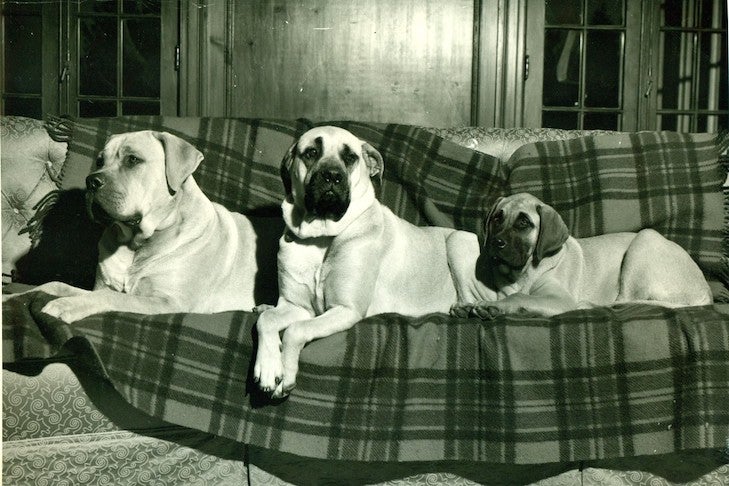
![Monge [?], Bullmastiff. 1963](https://www.akc.org/wp-content/uploads/2020/05/Bullmastiff_BreedStandards_003.jpg)
Why the Bullmastiff Was Developed
Nicknamed the Gamekeeper’s Night Dog, the Bullmastiff was developed in 19th-century Great Britain to enforce the game laws that kept poachers off sprawling estates, a job more dangerous than it might sound.
Stealing a nest of pheasant eggs or hunting a hare may seem a minor offense today. At the time, however, poaching could lead to severe fines, imprisonment, or even death if a confrontation turned violent.
Whether they were hunting to feed their families or for sport, poachers knew the risks and often came armed, frequently accompanied by a dog of their own.
Their primary adversary was the gamekeeper. Usually living on the estate of a wealthy landowner, the gamekeeper managed local wildlife populations, eliminated predators, trapped vermin, reared game birds, and patrolling the grounds to prevent poaching.
A Powerful Blend of Mastiff and Bulldog
As its name suggests, the Bullmastiff was created by crossing two native British breeds. The traditional “formula” was said to be 60% Mastiff and 40% Bulldog.
Regardless of the exact ratio, the result was a compact, athletic dog capable of covering short distances with impressive speed. Their substantial build allowed them to knock down a human opponent with ease. Powerful jaws and an undershot bite gave them the ability to hold a suspect securely until help arrived.
Unlike other guarding breeds, the Bullmastiff wasn’t bred to inflict serious injury. Instead, the breed’s purpose was to stop and restrain an intruder until the gamekeeper reached the scene.
During nighttime patrols, gamekeepers often maintained physical contact with the Bullmastiff walking dutifully beside them. When the skin on the dog’s broad head began to wrinkle and furrow in concentration, it signaled that someone or something was ahead.

The Fearless Reputation of the Gamekeeper’s Night Dog
The Bullmastiff earned a reputation not only for physical ability but also for remarkable courage.
“I would rather have one of these dogs with me in a night [fight] than three men,” Burton told a London newspaper in 1901.
The gamekeeper’s admiration extended beyond the breed’s strength. As Burton explained to “The Law” magazine in 1910, the terrier and sheepdog mixes used in Continental Europe as police dogs might be capable of tracking and chasing a criminal. They might even hold someone at bay until assistance arrived.
“But I venture to say that nine out of ten of such dogs would run yelping away at the first stroke from a good stick,” he said. “Not so the British bullmastiff. He knows no fear, and is prepared to take his death, and will do so no matter how great the odds are against him.”
The Bullmastiff Comes to America
Some of the first Bullmastiffs in the United States were imported by the wealthy Rockefeller family to patrol their vast, unfenced Pocantico estate north of Manhattan.
The Rockefellers’ first two full-grown males arrived in 1934 equipped with leather muzzles. Employee Tom Pyle described the dogs in his 1964 memoir “Pocantico: Fifty Years on the Rockefeller Domain.”
“They were big, biscuit-colored dogs, weighing around 140 pounds – about my own weight, but they had better teeth,” he recalls.
Pyle later recounted how his boss suggested they test the dogs on each other. In a real-life echo of Burton’s famous wager, Pyle hid in a field while the other man released one of the Bullmastiffs.
“Prince ran a few yards, stopped, hooked both feet over his muzzle, and, to my horror, ripped it off,” Pyle wrote, “then came at me full tilt.”
Pyle quickly climbed a nearby training platform and escaped unharmed. Unsurprisingly, the two men never swapped places.
From Estate Protector to Family Companion
More than a century after Burton demonstrated the abilities of his dogs before crowds of gamekeepers and sportsmen, the Bullmastiff remains a respected and recognizable breed.
Although their working role has changed dramatically, the qualities that made them successful estate guardians still shine through. Generations of selective breeding have transformed the Bullmastiff from a poacher’s worst nightmare into a devoted family companion.
Today’s Bullmastiff is generally calmer and more adaptable than its early ancestors, but the breed continues to be known for loyalty, confidence, and a natural instinct to protect loved ones.
You can bet on that.
Key Takeaways
- The Bullmastiff was developed in 19th-century Britain to help gamekeepers stop poachers on large estates.
- The breed originated from crosses between Mastiffs and Bulldogs, combining power, athleticism, and courage.
- Bullmastiffs were bred to restrain intruders rather than seriously injure them.
- William Burton’s famous Thorneywood dogs helped establish the breed’s reputation for reliability and fearlessness.
- Today’s Bullmastiff remains known for loyalty, confidence, and protective instincts, even though its original working role has largely disappeared.
Frequently Asked Questions
-
Why was the Bullmastiff called the Gamekeeper's Night Dog?
+
The breed was developed to accompany British gamekeepers on nighttime patrols. Bullmastiffs were trained to locate poachers, chase them down, and hold them until the gamekeeper arrived.
-
What breeds were used to create the Bullmastiff?
+
The Bullmastiff was developed from crosses between Mastiffs and Bulldogs. A traditional description of the breed’s foundation suggested approximately 60 percent Mastiff and 40 percent Bulldog.
-
When did Bullmastiffs come to the United States?
+
Some of the earliest Bullmastiffs arrived in America in 1934 when the Rockefeller family imported dogs to patrol their Pocantico estate in New York.
-
Are modern Bullmastiffs still protective?
+
Yes. Although they no longer work as estate patrol dogs, Bullmastiffs retain the loyalty, confidence, and guardian instincts that made them effective protectors in the past.
Curious about your dog’s history? Purchase an AKC Certified Pedigree to access your dog’s official family tree. Learn if they have a Champion bloodline, discover foreign ancestors, and see any recorded health certifications. Handsomely printed, our AKC Certified Pedigree is available for purchase online with up to four generations.