AKC is a participant in affiliate advertising programs designed to provide a means for sites to earn advertising fees by advertising and linking to akc.org. If you purchase a product through this article, we may receive a portion of the sale.
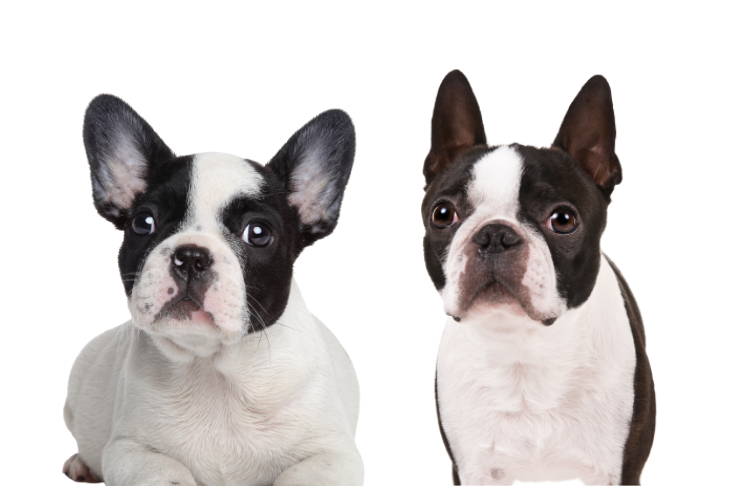
The French Bulldog, one of the most popular dog breeds around, and the Boston Terrier, state dog of Massachusetts, are both adorable companions. Sharing fabulous ears and distinct faces, these small and compact members of the Non-Sporting Group both adapt well to an urban environment. But if you see them walking down the sidewalk, can you tell them apart? When you consider Boston Terriers vs. French Bulldogs, there is a passing resemblance, but delve deeper, and you’ll see where the fascinating differences lie.
Originating in Different Countries
Both breeds share a bulldog-related heritage, but there’s more to the story than that. Robin Stansell, past Judges Education Chair for the French Bull Dog Club of America who has shown and bred Frenchies since 1991, says the French Bulldog originated in England as a toy Bulldog during the Industrial Revolution. When English lace makers were replaced by mechanical weaving machines, many of the lace makers immigrated to France to find work. “The toy Bulldogs were favored by these lace makers as they were smaller and cheaper to maintain in the small tenements in France. There the dogs mixed with local breeds resulting in some physical changes in the breed including some with erect ears.”
-

- French Bulldog

-
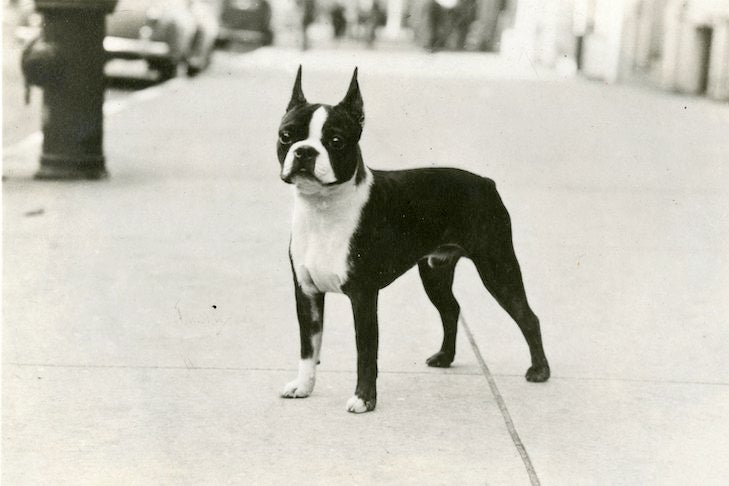
- Ch. Calsen’s Best Regards, Boston Terrier. 1946
Eventually, American businessmen met the breed in France and brought them home to New York. The little dogs with the “bat ears” gained popularity until they became the most popular dog in the United States. Stansell explains, “When an English judge only selected Frenchies with the traditional ‘rose ear’ at the 1896 Westminster Kennel Club show, the Americans were distressed. In 1897, the French Bull Dog Club of America was formed and wrote the first breed standard, disqualifying ears other than the ‘bat ear.'”
The Boston’s origins are closer to home. Recognized in 1893 by the AKC, the Boston Terrier originated in the Boston, Massachusetts area. Thomas J. Davis, AKC Judge and mentor for the Boston Terrier Club of America who has been breeding and exhibiting Boston Terriers for 40 years, explains that this truly American breed was originally a cross between an English Bulldog and the now-extinct White Terrier. “They were developed for a new smaller and more athletic fighting dog. Obviously, that did not happen and was a disappointment to the breeders of that time. The Boston Terrier is a loving and gentle breed.”
A Passing Physical Resemblance
When you look at the physical characteristics of the Boston Terrier vs. the French Bulldog, you’ll see the shared traits of compact bodies and short muzzles. However, Davis says he doesn’t understand why people often confuse the two especially given that they have different side profiles, head types, ear shapes, and toplines. “The only similarities are that both have erect ears, and both are brachycephalic breeds.”
-
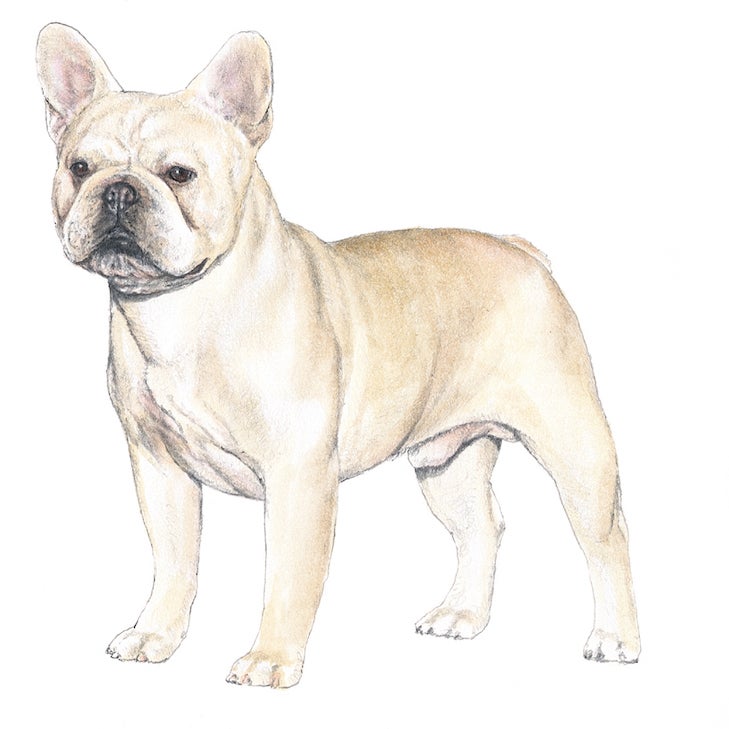
- French Bulldog Illustrated Breed Standard
-
- Boston Terrier Illustrated Breed Standard

They both also have a smooth coat. French Bulldogs can be brindle, fawn, white, or brindle and white. Whereas Boston Terriers always have their distinctive tuxedo that has earned them the nickname “The American Gentleman.” However, that tuxedo can be white and either black, brindle, or dark brown. The Frenchie can also be a wee bit taller, with a height at the shoulders of 11–13 inches versus the Boston’s 10–12. Finally, Frenchies are under 28 pounds and Bostons are 12–25.
Stansell believes the two breeds can be confused if the Frenchie has markings like the Boston. But outside of color, he feels they can be easily distinguished as the Frenchie has more substance and heavier bone, a pear-shaped body, and a wider range of colors and markings. “The Boston Terrier must have the characteristic ‘tuxedo-like’ markings with a level topline and a double-tracking gait.”
Loving Companions Who Want to Be With You
French Bulldogs aren’t at all as stubborn as their reputation. Most of them do their utmost to please their humans and are trainable with the right motivation, which is usually food. These charming dogs have an affectionate, bright personality and enjoy meeting new human friends. Even though French Bulldogs make great watchdogs, they don’t bark much. Stansell describes them as a joy to live with. “They are playful and love being with you. Given the opportunity, they will take charge of your activities as well as your bed!
However, they may not want to share you with other dogs.”
Bostons are good with people of any age and even other pets. They’re also fast learners and highly intelligent making them great for dog sports. But the job they excel at most is being your best friend. They were bred to be companions, so they’re happiest when with their humans and therefore require a lot of your time and attention. Davis says, “Boston Terriers are not a dog to lie on the floor or sit in a corner. They always must be touching you – sitting on your lap, staring in your eyes, laying in your bed, cuddling next to you, sometimes on your pillow or under the covers.”
Special Concerns for These Dogs
Both breeds share certain health considerations due to their short faces which can impact their breathing. First, it’s important to take extra care in hot or humid weather, so the dogs don’t overheat. For example, using air conditioning in the house or car is a must. Second, both are more sensitive to anesthesia, so be sure to choose a veterinarian who is experienced with these breeds.
Frenchies should have a thorough musculoskeletal examination from a vet as these stocky dogs may have abnormal vertebrae and/or premature degeneration of the discs in their spine. And because they’re front heavy, French Bulldogs can’t swim. Never leave them unattended near water. Sometimes they can have eye conditions including cherry eye, entropion (inward rolling eyelid), and juvenile cataracts. They must be kept at an appropriate weight because extra pounds put the dog at higher risk of health issues.
The Boston Terrier’s eyes also need special attention and should be checked daily for any irritation or redness. Choose a responsible breeder who screens their dogs for eye problems as well as deafness and luxating patella (dislocated kneecap).
Weekly Brushing Ensures a Healthy Coat
Neither dog has heavy grooming demands as they both have short coats that don’t shed very much. Weekly brushing with the right grooming tool, like a bristle brush, rubber grooming mitt, or a hound glove will remove loose fur and distribute oils through the coat. Occasional baths are enough, but Frenchies need regular cleaning of their deep facial folds to protect them from becoming irritated.
Great Partners for Dog Sports
-
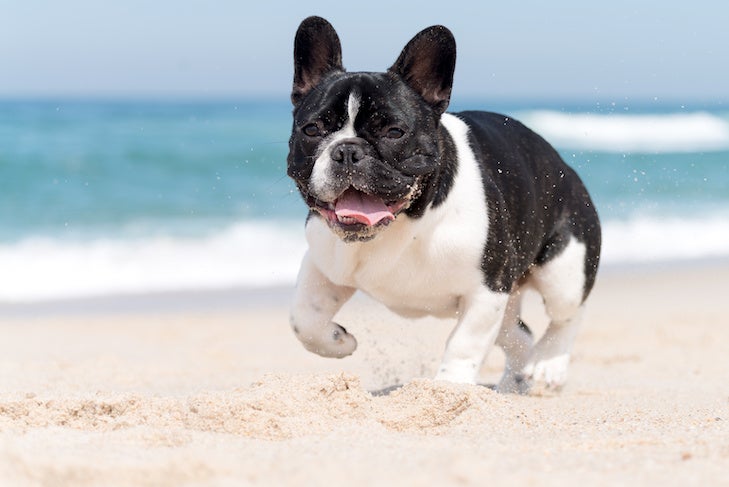
- French Bulldog running
-
- Boston Terrier running

When it comes to Boston Terriers vs. French Bulldogs, both need moderate physical exercise. But the Boston is quite the athlete and can sail over jumps and race around a sporting event with the best of them. Because they’re fast learners, Boston Terriers do well in obedience, AKC Rally, Therapy Dog, agility, flyball, Fast CAT, Diving Dogs, and even weight pulling!
A Frenchie’s exercise needs can be met with a short walk or outdoor play session each day. However, they enjoy participating in sports like obedience, agility, and AKC Rally. Some even participate in tracking or coursing, and they make wonderful therapy dogs. Just take care not to make exercise overly strenuous, especially in warm weather.
You might wonder is the French Bulldog the right dog for you. Well, this loveable little dog in a small, muscular body might be your match. Or maybe the lively and intelligent Boston Terrier in a permanent tuxedo is the dog for you. Either way, now if you meet them on the street, you’ll be able to distinguish between these two fabulous breeds.