AKC is a participant in affiliate advertising programs designed to provide a means for sites to earn advertising fees by advertising and linking to akc.org. If you purchase a product through this article, we may receive a portion of the sale.
Regardless of how diligent a dog owner you are, accidents happen. Whether it’s a minor scrape or a large laceration, understanding the basics of dog wound care and knowing when to seek help from your veterinarian will help minimize stress, reduce the risk of infection, and promote faster healing.
Why Is Dog Wound Care So Important?
That small cut on your dog’s leg might not look all that serious, but if you leave it untreated or don’t treat it properly, it can quickly become a bigger problem, especially if bacteria enter the wound. “Proper wound care prevents infection, speeds up healing, and reduces the risk of complications like infections, painful abscesses, or deeper tissue damage,” explains Dr. Jamie Richardson, Head of Veterinary Medicine at Small Door Veterinary.
Wounds are injuries that involve damage to the body’s living tissue. Closed wounds, such as bruises or contusions, involve damage to underlying tissue, but the skin remains intact. We will focus on open wounds, which damage the skin, such as scrapes, cuts, tears, punctures, and burns.
Dog Wound Emergency First Aid

You may need to administer emergency first aid for more serious wounds before your dog receives appropriate professional care. This could be while transporting your dog to the veterinary hospital or if there is a delay in treatment because you are in a remote location.
-
Wear disposable gloves (if possible): This reduces the risk of spreading contaminants and infections, adding a layer of protection for your dog and you
-
Use a muzzle (if possible): Even the most even-tempered dog can react unpredictably when in pain. If you don’t have a muzzle readily available, you could also try to make a make-shift muzzle using show string or a belt depending on the size of the dog. This is especially important if working on a stray dog or one whose vaccine history is unknown.
-
Apply pressure to actively bleeding wounds: Do this until the bleeding stops or, in the case of serious open wounds, until you reach the veterinary hospital. If you have clean, dry gauze, apply this first, followed by a clean, dry cloth on top to protect the wound from further contamination. Apply pressure for at least three minutes before checking if the bleeding has stopped to allow clotting.
-
Raise bleeding wounds: Lifting the affected area above your dog’s heart level can help slow the bleeding
-
Clean the wound: Doing this if you can’t get to a vet immediately and any bleeding has stopped helps reduce the risk of infection. “Wounds can be flushed with warm water and then cleaned with dilute chlorhexidine solution,” Dr. Brian Collins, DVM and Extension Associate with the Cornell Riney Canine Health Center at the Cornell University College of Veterinary Medicine, says.
-
Apply a barrier: “If there is a delay in being able to seek veterinary advice, you can apply a barrier layer to the wound such as Aquaphor or Vaseline to help avoid dirt and bacteria entering,” Dr. Collins says
When Is At-Home Care Appropriate?

When in question, always call your veterinarian for advice on caring for a dog’s injuries. “Minor cuts or scrapes can often be managed at home if they’re shallow, not bleeding heavily, and your dog is acting normally,” Dr. Richardson says. “But anything deep, actively bleeding, swollen, or showing signs of infection should be examined by a veterinarian.”
When assessing your dog’s wounds, if they have any of the following, seeking veterinary assistance is advisable:
-
Full skin-thickness lacerations
-
Wounds that are actively bleeding, even after applying pressure for a few minutes
-
Wounds close to or on the eye
-
Puncture wounds, especially if on the chest or abdominal cavity
-
Wounds containing foreign objects
-
Wounds causing lameness or other signs of significant pain or discomfort
-
Wounds that are red, hot, swollen, odorous, or producing pus or other discharge
Your veterinarian will prioritize stabilizing your dog if they’re in a serious condition, cleaning the wound, and assessing whether to surgically close it or leave it open to reduce the risk of infection. They can then provide you with specific guidance for ongoing at-home care and, when necessary, prescribe medication.
Ongoing At-Home Dog Wound Care Guidance
While it’s important to follow any specific care instructions your veterinarian provides, below is some general at-home dog wound care guidance.
Wound Cleaning
Cleaning the wound and the surrounding area daily helps reduce the risk of infection and promotes the development of healthy new tissue. Veterinarians often use pet-safe antiseptic solutions such as diluted chlorhexidine or povidone-iodine (Betadine). While these are available over the counter, it’s essential to water them down properly, otherwise they can slow wound healing.
“A common adage when cleaning wounds is, ‘the solution to pollution is dilution’,” Dr. Gerard Ferrick, veterinarian and Medical Director at Thrive Pet Healthcare in Natick, Massachusetts, says. “For chlorhexidine solution, we aim for 0.05% and iodine 0.1% (the color of weak tea).”
A saline solution is a gentle and effective option for daily cleaning. “You can use salt water made by diluting 2 cups of water with 1tsp of table salt,” Dr. Collins says. “Gently flush the area, pat dry, and apply a vet-recommended antibiotic ointment if advised.”
Dr. Ferrick explains that dog owners often apply Bacitracin or Neosporin to wounds. “This may be fine in a lot of cases, but it is important to note that a small subset of patients may have allergic reactions to one or more of the components in certain over-the-counter medications,” he says. It’s better to opt for antibacterial products designed specifically for dogs.
Dress the Wound
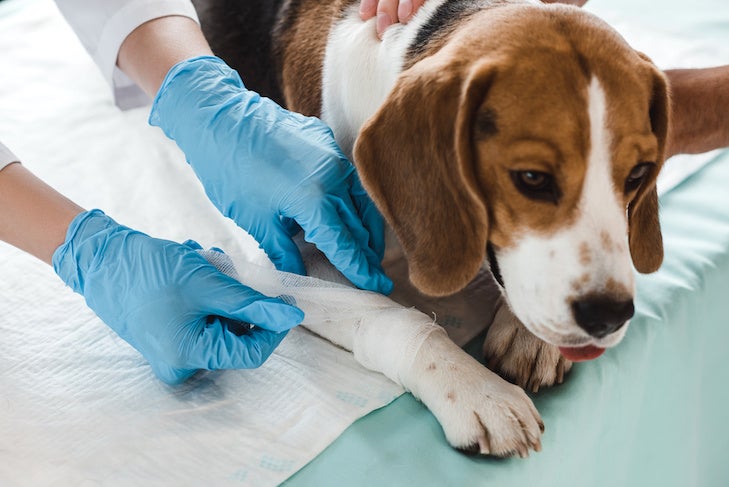
Some wounds can be left undressed, and some are in locations that will benefit from the application of antimicrobial ointment and then an adhesive gauze dressing. Others may require protective bandaging to help keep the wound clean and debris-free.
Unless your veterinarian instructs you on how to do it, it’s best to avoid bandaging your dog’s wounds yourself. “While putting a bandage on is almost always well-intentioned, unfortunately this can exacerbate the injury and even cause other adverse sequelae [complication or condition that results from a pre-existing injury], such as excessive compression and cutting off blood supply to tissue,” Dr. Ferrick says. “Also, if a wound has not been properly addressed and cleaned prior to bandage application, it is a prime environment to trap infection.”
Dr. Ferrick describes bandaging as an art form requiring great care and precision. He explains that sometimes a bandage can also overserve the needs of the dog’s injury, and in other circumstances, it’s best to leave the wound open to heal. It can also be tricky to keep bandages dry, and wet bandages need to be changed immediately.
“Owners can be creative by using other maintenance measures after cleaning such as loose-fitting t-shirts, socks, tubes, protective boots, etc,” Dr. Ferrick says.
Administer Prescribed Medications
Only administer any antibiotics, pain medications, or anti-inflammatory drugs your veterinarian prescribes as instructed. Discontinuing a course of antibiotics early can increase the risk of an infection not clearing or recurring and contribute to problems with antibiotic resistance. Giving human anti-inflammatory medication is often toxic to dogs.
What Not to Do When Caring For a Dog’s Wound

To promote healing, reduce the risk of infection and keep your dog comfortable, there are some things you should avoid when caring for wounds.
-
Don’t let your dog lick the wound: “While it’s a common myth that dog saliva helps wounds heal, licking can actually introduce bacteria from the dog’s mouth, and delay healing,” Dr. Richardson says. “It can also reopen scabs or cause trauma to the area, increasing the risk of infection.” This is where Elizabethan collars or protective t-shirts are your best friend (even if your dog doesn’t love them).
-
Don’t use hydrogen peroxide or rubbing alcohol: “These can be damaging to the healthy tissue around the wound,” Dr. Collins says.
-
Don’t let your dog swim or be overly active: While the moisture from ointments can help promote wound healing, wet wounds are more likely to get contaminated and heal slower. Plus, allowing your dog to run and jump increases the chance of healing wounds opening up.
How Do I Know If a Wound Is Healing?
While a degree of redness and swelling is to be expected with a wound initially, Dr. Collins recommends having a vet evaluate it if it’s worsening or not improving after a few days. “An unpleasant odor or discharge of any color is not normal and should be assessed,” he says. “The skin should not have a black or grayish appearance, and signs of pain are also a concern.”
You should also be vigilant if a bandage covers your dog’s wound. “If you notice that the bandage slips or becomes moist or wet, your dog is reluctant to use the affected limb or paw, has excessive discomfort associated with the bandage, swelling of the exposed digits (or other areas above or below the bandage), or you note ‘strikethrough’ (the visible presence of blood or discharge on the outside of a bandage), your pet should be evaluated promptly,” Dr. Ferrick says.
If you have any concerns about your dog’s wound, it’s always best to contact your veterinarian for reassurance or ongoing advice.
This article is intended solely as general guidance, and does not constitute health or other professional advice. Individual situations and applicable laws vary by jurisdiction, and you are encouraged to obtain appropriate advice from qualified professionals in the applicable jurisdictions. We make no representations or warranties concerning any course of action taken by any person following or otherwise using the information offered or provided in this article, including any such information associated with and provided in connection with third-party products, and we will not be liable for any direct, indirect, consequential, special, exemplary or other damages that may result, including but not limited to economic loss, injury, illness or death.