When you mention the “Siberian Husky,” many envision sled dogs racing across vast ice fields. Although the Siberian Husky and the Alaskan Malamute pull sleds and originate from Arctic regions, they’re distinct breeds with different origins, physical traits, and temperaments.
The medium-sized Siberian Husky is often affectionately referred to as the “Sibe.” They’re renowned for their alertness, energy, and adaptability. While affectionate on its terms, this breed possesses a thick double coat that reflects its Arctic heritage, helping keep the dog warm and dry in snowy conditions, which are essential for its survival.
The Siberian’s intelligence, inquisitiveness, and sense of humor, combined with a strong desire to run, make this medium-sized working dog an ideal companion for many performance events.
The Siberian Husky’s Early Northern Origin
The Siberian Husky originated as a primitive breed in Siberia, the northernmost region of Asia, located west of the Ural Mountains, which serve as the dividing line between Europe and Asia. It’s bordered on the north by the Arctic Ocean, on the south by the countries bordering the Russian Federation, and on the east by the Bering Sea and the Pacific Ocean.
For approximately 30,000 years, the Chukchi people have lived in Siberia’s far northern and eastern regions. This desolate land mass, closest to Alaska, connects to the frozen Bering Strait, has limited vegetation, and is characterized by harsh winds blowing in from the water, mountains, and tundra.
Harnessed in teams for transportation, the ancestors of the modern Siberian Huskies provided crucial support to the semi-nomadic Chukchis, providing transportation as they completed hunting, fishing, and trapping tasks. The Siberian’s speed and endurance enabled the Chukchis to travel long distances over treacherous terrain and to develop the breed further. The sled dogs enabled the Chukchis to encounter other Asian people and trade with neighbors in Alaska. Russians soon settled in the Alaskan territory due to its proximity to Siberia.
“When Russian officers in the Alaskan territory came on horseback to take over the Chukchis, the tribe harnessed their Siberian Huskies and pulled their sleds to escape,” says George Cook, President of the Siberian Husky Club of America. “The dogs were so fast the Russians could never catch up with them.”
The First Sled Dog Races

The United States purchased Alaska in 1867 and later made it a U.S. territory. In 1896, gold was discovered in Canada’s Yukon territory. The gold rush prompted the need for dog teams to transport prospectors to the area. “The dogs proved an invaluable part of moving around the gold fields,” Cook says. During the winter months, gold mining halted. Miners sat around bragging, ‘My dog team is faster than your dog team.’ “This was the birth of sled dog racing,” Cook says.
In 1909, the All-Alaska Sweepstakes, a 408-mile race in the Nome, Alaska area, offered a $10,000 first prize. William Goosak, a Russian fur trader, brought his team of Siberians to enter the All-Alaska Sweepstakes.
The following year, Fox Maule Ramsay acquired 60 Siberians and entered three teams in the competition. Ramsay was a young Scotsman and also competed in the 1909 race. One of these teams was driven by John “Iron Man” Johnson. He won first place with a time of 74 hours, 14 minutes, and 37 seconds. Goosak’s team established a trend of importing northern sled dog breeds, which became known as the Siberian Husky.
Life-Saving Siberian Teams

When a spreading diphtheria epidemic threatened Nome in January 1925, the closest serum was over 600 miles away. A team of Siberians ran a relay to deliver the serum. Leonhard Seppala had trained Siberians for an expedition to the North Pole in 1914. They’d won three Sweepstakes races in 1915, 1916, and 1917 before World War I cancelled future races. Seppala and his team of 20 Siberians ran to meet the serum 300 miles away on the Yukon River. During a blizzard, Seppala and his leader, “Togo,” and another team, driven by Gunnar Kaasen and his lead dog, “Balto,” ran the last leg of the relay.
Following the heroic serum relay, Seppala and 40 Siberian Huskies, including Togo, toured U.S. cities from Nome to New York City in 1926. In New England, Seppala won a prestigious New England Point to Point 3-day race. He later established a kennel with Elizabeth Ricker, a New England musher, at Poland Spring, Maine, as other mushers wanted to acquire Siberians. Seppala returned to Alaska for the last time in 1932 and left his remaining Siberians with Harry Wheeler in Quebec. Many Siberians today trace their ancestry to the Seppala-Ricker kennel or Wheeler’s kennel, which is still in operation today.
Flights of Fancy

In April 1930, the American Kennel Club recognized the breed. The Siberian Husky Club of America was established in 1938, and it received recognition from the AKC in 1946.
Stories about the serum relay and the breed’s fortitude as a tireless sled dog first attracted Cook and his wife, Ann Mariah Cook, to the breed when the couple were in college.
“We started with a three-dog team in Connecticut and later realized that five dogs can run faster,” Cook says. “We moved to New Hampshire for more land and began breeding Siberians.”
The Cooks later moved to Alaska with their daughter and Siberian Huskies to run the 1,000-mile Yukon Quest. “It was tough,” Cook recalls. “The race was 16 days in 30 to minus 60-degree weather, but I was determined to be the first person from the lower 48 states to finish this race.”
The rules require mushers to start with 12 dogs and finish with nine without substituting any dogs. Cook finished with all 12, including his lead dog Keewatini’s Mighty Mishka “Minnie.”
The Siberian Performance Dog
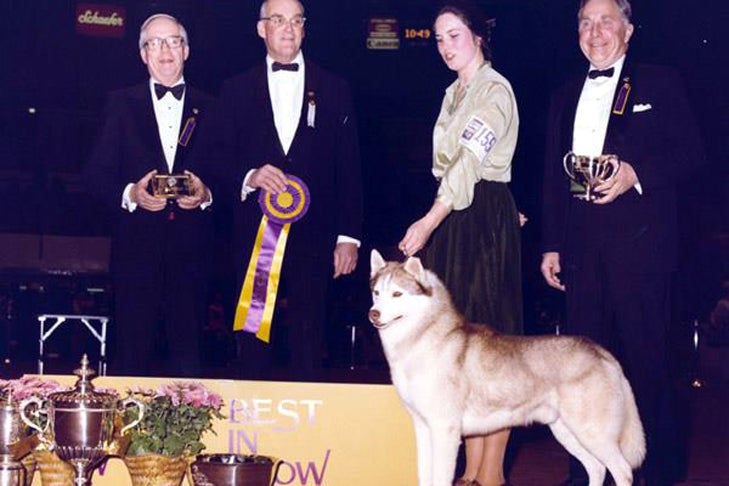
“The Siberian is mischievous, engaging, and highly intelligent,” says Deb Kreider, Public Education Chair of the Siberian Husky Club of America. “They began as a primitive breed, [which] allowed them to survive the harsh conditions in an unfriendly environment. It’s this stamina that makes them a great performance dog.”
Kreider’s first Siberian, Ch. Innisfree Rondevous “Pal,” earned Canine Good Citizen and AKC Rally Novice titles. “I quickly became addicted to sledding and how versatile the breed is. Pal accompanied me on therapy visits to schools,” Kreider says. “A great listener, he loved the kids and was easy around other dogs. When my friend’s mother, Kathleen Kantzler, invited me to go sledding, I was hooked.”
Owners need to train their Siberians not to run off when they’re off leash, Kreider says. “The AKC Family Dog program with AKC Fetch, AKC FIT DOG, AKC Fast CAT, AKC Rally, and the AKC Canine Good Citizen program is fantastic for training Siberians and building their confidence before going off lead, but it takes training and consistency,” Kreider says. “The breed is so versatile and appreciates positive feedback and engagement with you. Otherwise, they will find better things to do.”