There is such a thing as being too good at your job. Just ask the Irish Wolfhound.
For centuries, the Irish Wolfhound was revered in Ireland for its size, bravery, and hunting skill. Originally used to hunt large game and wolves, the breed became a symbol of status among nobles and warriors. After wolves disappeared from Ireland, the breed itself nearly vanished. Thanks to the efforts of 19th-century breeders, however, the Irish Wolfhound was restored and survives today as a powerful yet gentle companion.
Ancient Origins of the Irish Wolfhound
As far back as Roman times, there were accounts of large Greyhound-like dogs in Ireland called cú faoil in ancient Gaelic. These dogs were prized for their size and ferocity. Some Irish chieftains and warriors even incorporated the word cú into their own names as an honorific, signifying that they were as venerable and loyal as the dogs themselves.
Like many Sighthounds of the distant past, ownership was generally reserved for the nobility. Over the centuries, these dogs became coveted gifts for emperors, ambassadors, kings, and cardinals. Historical accounts describe them being presented in symbolic groups of seven, often tied with silver chains.
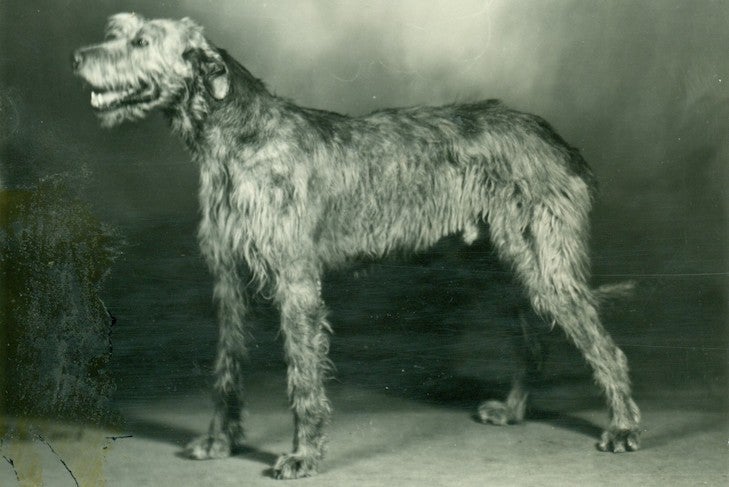
The Irish Hounds That Astonished Rome
In 391 AD, the Roman statesman Quintus Aurelius Symmachus wrote a letter thanking his brother for the gift of seven Irish hounds, noting that “all Rome viewed them in wonder.”
Another famous tale from roughly two millennia ago concerns a hound named “Ailbé.” So prized was the dog that two kings vied to own him. One reportedly offered “three score hundred milch cows at once and a chariot with two horses and as much again at the end of the year.” The dispute escalated into warfare, and Ailbé met a dramatic end after attacking a king’s chariot and seizing its axle. Even after being beheaded, the story claims, he continued to hold on.
Whether embellished or not, such stories reflect the iconic status of these imposing dogs. They served as guardians of property and livestock while also hunting deer, elk, boar, and wolves.
Their effectiveness at wolf hunting became especially renowned. In 1571, Edmund Campion wrote in his “Historie of Ireland” that the Irish people “are not without wolves and greyhounds to hunt them, bigger of bone and limb than a colt.”
The breed was so sought-after that Oliver Cromwell issued a declaration in 1652 prohibiting its exportation.
Folklore, Loyalty, and the Story of ‘Gelert’
The breed’s courage and devotion are woven into one of the best-known canine legends in British and Irish folklore.
According to the story, “Gelert,” an Irish hound, was gifted to Llewellyn, the prince of Wales, by King John of England in 1210. After returning from a hunt, Llewellyn found Gelert covered in blood and his infant son’s cradle overturned and empty. Believing the dog had killed the child, he struck Gelert with his sword.
As Gelert lay dying, Llewellyn heard the cries of his son, who emerged safely from beneath swaddling clothes. Nearby was the wolf Gelert had killed while defending the child.
Although some historians suggest the tale may have been invented centuries later to attract visitors to the area, the story’s enduring popularity speaks to the deep admiration people held for these hounds and the loyalty they represented.
How the Breed Disappeared
Despite their legendary reputation, the Irish Wolfhound’s purpose gradually faded.
As wolves disappeared from Ireland, so too did the need for specialized wolf-hunting dogs. The last wolf in Ireland reportedly died in 1786. Without a practical role and with generations of decline behind them, the dogs themselves became increasingly scarce.
By 1836, the breed appeared on a list titled “Notices of Animals which have disappeared from Ireland.”
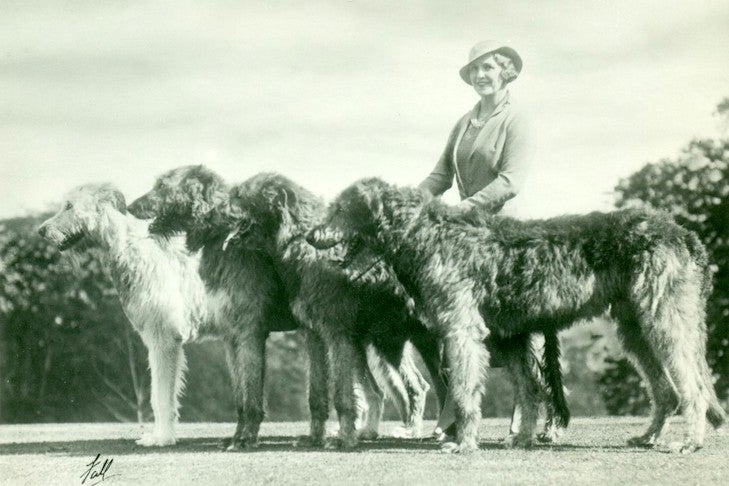
Captain George Augustus Graham’s Revival Effort
The modern Irish Wolfhound owes its existence largely to Captain George Augustus Graham, who undertook a breed restoration effort beginning in 1863.
Originally a Scottish Deerhound enthusiast, Graham obtained dogs descended from stock collected years earlier by H.D. Richardson. Those dogs were said to represent surviving strains of the old Irish hounds, though historians and breed experts continue to debate how closely they were related to the original wolf dogs.
Recognizing that these dogs alone were insufficient to rebuild the breed, Graham used Scottish Deerhounds and Great Dane crosses. These additions helped provide the size and substantial bone he believed the Irish Wolfhound should possess.
He also introduced Borzoi blood through a dog named “Korotai,” owned by the Duchess of Newcastle. There was also a one-time cross to a Tibetan Mastiff named “Wolf,” which some believe was actually a rare Tibetan Kyi Apso. Two of Wolf’s daughters, “Vandal” and “Nookoo,” appear in the ancestry of every Irish Wolfhound alive today. Additional influence came through Garnier’s Lion, a Mastiff whose offspring with a Scottish Deerhound named “Lufra” entered Wolfhound pedigrees.
Creating the Modern Irish Wolfhound
Even Graham acknowledged that the dogs he was developing lacked the “original integrity” of their ancient predecessors.
To guide his breeding program, he commissioned a life-size cardboard model depicting his ideal Irish Wolfhound. Painted gray, the model stood 35 inches at the shoulder, measured approximately 42 inches in girth, and weighed an estimated 140 pounds.
Reflecting on the result, Graham wrote: “It presents to the vision a most striking and remarkable animal of a very majestic and beautiful appearance, far, far beyond any dog the writer has ever seen.”
The model no longer exists, but surviving photographs reveal a remarkably familiar silhouette. The dog combines great size and substance with the flowing lines of a Greyhound, a balance Graham considered essential.
He cautioned breeders against focusing solely on height, writing in the “Kennel Encyclopaedia” in 1907: “An all-round sound dog of medium height is far preferable to an overgrown badly-shaped, crooked-legged giant; for size, though most important, cannot in any way make up for unsoundness.”
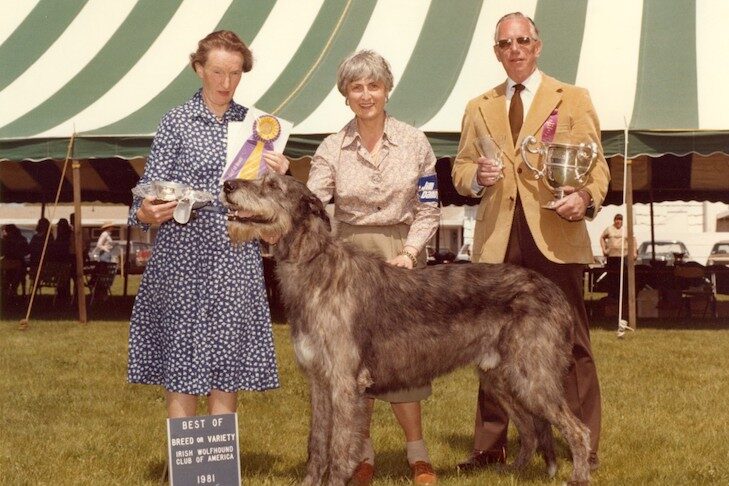
Recognition and Enduring Popularity
Irish Wolfhounds first appeared in the show ring in Dublin in 1879 and again in England in 1881, where they were registered under “Foreign Breeds.” Early examples illustrate how fluid the developing breed remained, with some dogs previously shown as Deerhounds or sharing litters with Deerhound-registered siblings.
By 1885, Graham and his supporters considered the breed stable enough to establish the Irish Wolfhound Club. An official breed standard followed the next year.
Today, the Irish Wolfhound remains true to Graham’s vision. The breed combines power, speed, and unmistakable presence while maintaining the gentle temperament that has made it a beloved companion. Whether Graham revived a fading breed or effectively created a new one remains a matter of debate, but the Irish Wolfhound’s future appears far more secure than its past.
Key Takeaways
- The Irish Wolfhound descends from ancient Irish sighthounds prized for hunting wolves, deer, boar, and other large game.
- Irish Wolfhounds were so highly valued that they were given as gifts to emperors, kings, nobles, and other influential leaders.
- The breed nearly disappeared after wolves became extinct in Ireland and its traditional hunting role was no longer needed.
- Captain George Augustus Graham led the 19th-century effort that rebuilt the Irish Wolfhound using surviving bloodlines and carefully selected crosses.
- The modern Irish Wolfhound is admired for combining great size and athletic ability with the gentle temperament that earned it the nickname “gentle giant.”
Frequently Asked Questions
-
What were Irish Wolfhounds originally bred to hunt?
+
Irish Wolfhounds were originally bred to hunt wolves as well as other large game, including deer, boar, and elk. Their size, speed, and strength made them highly effective hunters.
-
How old is the Irish Wolfhound breed?
+
The Irish Wolfhound traces its ancestry to ancient Irish hounds that were documented as far back as Roman times, making it one of the oldest known sighthound-type breeds.
-
Why did the Irish Wolfhound nearly become extinct?
+
The breed declined after wolves disappeared from Ireland because there was no longer a need for large wolf-hunting dogs. Over time, numbers dwindled until the breed became extremely rare.
-
Who is responsible for saving the Irish Wolfhound?
+
Captain George Augustus Graham is widely credited with restoring the Irish Wolfhound during the 19th century through a carefully planned breeding program.
-
When did the Irish Wolfhound become recognized by the AKC?
+
The Irish Wolfhound was first recognized by the American Kennel Club in 1897 and is currently a member of the Hound Group. The breed remains one of the AKC’s tallest recognized breeds and is known for combining impressive size with a gentle temperament.