AKC is a participant in affiliate advertising programs designed to provide a means for sites to earn advertising fees by advertising and linking to akc.org. If you purchase a product through this article, we may receive a portion of the sale.
As much as you love your dogs’ company, you may not want them to have access to every room in your home all the time. A dog gate can help prevent falls, keep dogs away from household hazards, support house training, and manage interactions with other pets or young children.
In This Article
With different materials and safety features to choose from, you might be wondering whether you need to purchase a dog gate for your home and which type is best for your dog. Choosing the right gate depends on your home’s layout and your dog’s size, behavior, and temperament.
When Would You Want to Use a Dog Gate?
Dog gates can be useful whenever you need to limit your dog’s access to certain parts of your home. Common reasons include keeping dogs away from stairs, hot appliances, cleaning products, medications, and other household hazards. Gates can also help protect valuable belongings and keep specific rooms cleaner.
Whether you have a new puppy or an adult dog, using a gate can also be helpful when introducing a new dog to your home. “During house training, gates can limit a puppy’s access to areas where accidents are more likely to happen,” says Dr. Kelly Hood, DVM, in-house veterinary expert at PetPortraits.com. Unless you’ve cleaned up urine thoroughly, lingering odors may encourage a dog to return to the same spot.
Dr. Hood also notes that gates can help separate dogs or other pets that don’t get along. Your dog may need to be separated while eating, taking medications, or being groomed. Gates can also provide an extra layer of safety in households with infants or toddlers.
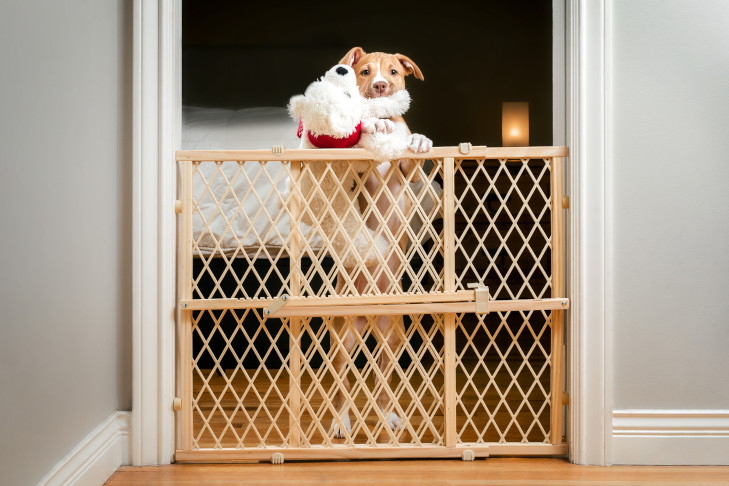
Understanding the Different Types of Dog Gates
Dog gates generally fall into three categories: pressure-mounted, hardware-mounted, and freestanding.
Pressure-Mounted Gates
Pressure-mounted gates are “a good option if you’re renting or aren’t looking to make permanent changes,” Dr. Hood explains. These gates use rubberized tension knobs and an adjustable frame to stay securely in place.
Because they don’t require tools or hardware, they’re easy to install, remove, and relocate throughout the home.
Hardware-Mounted Gates
If you’re looking for a more permanent solution, hardware-mounted gates are more secure. “They’re better for the top of stairs or if you have an energetic or larger dog,” she says.
These gates are attached to a wall or doorway using brackets or bolts, making them more secure than other options. The tradeoff is that they’re designed to stay in one location and are less convenient to move.
Freestanding Gates
Freestanding gates require no installation and can be placed where needed. Many models include support feet, rubber grips, or hinged panels that allow different configurations.
These gates can be useful for blocking off fireplaces, creating temporary barriers, or enclosing unusually shaped spaces. Dr. Hood explains that they are “useful for creating temporary barriers or enclosing spaces that are oddly shaped, but they aren’t as secure as other types of gates.”
Ultimately, the best choice depends on your goals. Portability may make a freestanding gate attractive, while households with larger or more determined dogs may benefit from a hardware-mounted model. Some pressure-mounted gates can also be secured with additional hardware for added stability.
What Materials Are Safest for Dogs?
Dog gates are commonly made from metal, wood, plastic, or a combination of materials. Each comes with advantages and limitations.
“Metal gates are usually the most durable and chew-resistant, so they’re great for dogs who are persistent chewers,” Dr. Hood says.
Wooden gates can be an attractive option for many homes, but Dr. Hood recommends selecting products finished with pet-safe materials.
Plastic gates are often more affordable and lightweight. However, lighter construction may not stand up to a large dog or one determined to get through the barrier. As Dr. Hood notes, “they might not withstand a bigger dog or a dog that’s really determined to get past it.” She adds, “The most important thing when choosing a gate is that it’s sturdy enough for your dog’s size and temperament.”
How to Choose the Right Size Dog Gate
Before purchasing a gate, carefully measure the width of the doorway, hallway, or opening where you plan to install it. Most gates offer adjustable sizing within a specific range, so confirm that your measurements fall within the product’s specifications.
You should also check for any listed weight limits and evaluate whether the gate is appropriate for your dog’s size and activity level.
Height is just as important as width. Beyond simply being tall enough, consider whether your dog could use nearby furniture to climb over the gate.
“The gate should be tall enough so that your dog can’t jump over it,” Dr. Hood says. A gate that is 20 inches high may work well for puppies or small breeds. “For bigger breeds or jumpers, you’ll probably need a gate that’s at least 30 inches high,” she says.

Are Baby Gates Safe for Dogs?
Many baby gates are made from the same materials as dog gates, but they’re not always built to withstand canine behavior. Baby gates are often lighter, shorter, and less resistant to chewing, scratching, and pushing.
Although a dog gate should not be used as a substitute safety device for babies or toddlers, “baby gates can work for dogs in many cases, but they’re not always ideal,” Dr. Hood says.
Dog-specific gates are generally more durable and are designed with canine habits and behaviors in mind. When comparing products, look for openings that are small enough to prevent a dog’s paws or head from becoming trapped.
It’s also wise to choose a gate with a secure, pet-resistant lock. The latch should be easy for people to operate while remaining difficult for curious or determined dogs to open. If your dog is known to climb, avoid gates with horizontal bars that could provide footholds.
How to Train Your Dog to Respect a Gate
Most dogs need time to adjust to a new gate. Introducing it gradually can make the process easier.
“Start by letting them investigate the gate while it’s open,” she says. “Then close it and reward your dog for calm behavior near the gate.”
Even if the gate is strong enough to withstand jumping or scratching, it’s important to discourage those behaviors. Redirect your dog when they paw at or jump on the gate, and reward calm behavior with praise or treats.
“With time and consistency, most dogs will eventually learn to accept the gate as part of their environment,” she adds.
Key Takeaways
- Dog gates help improve safety, support training, and manage access throughout the home.
- Pressure-mounted, hardware-mounted, and freestanding gates each serve different purposes.
- Hardware-mounted gates are generally the safest option for stairways and large dogs.
- Choose a gate based on your dog’s size, behavior, chewing habits, and ability to jump.
- Introducing the gate gradually and rewarding calm behavior can help dogs adjust more easily.
Frequently Asked Questions
-
Which type of dog gate is best for stairs?
+
Hardware-mounted gates are generally considered the safest option for the top of staircases because they are securely attached and less likely to fail under pressure.
-
Do large dogs need taller gates?
+
Usually, yes. Large dogs and athletic breeds often require gates at least 30 inches tall, and some may need even taller barriers depending on their jumping ability.
-
Are metal or plastic dog gates better?
+
Metal gates are typically more durable and chew-resistant. Plastic gates may work well for smaller or calmer dogs but often provide less strength for larger breeds.
-
Can a puppy use the same gate as an adult dog?
+
Possibly, but puppies grow quickly. Consider whether the gate will remain an appropriate size and strength once the puppy reaches adulthood.
-
How long does it take for a dog to get used to a gate?
+
Many dogs adjust within a few days or weeks when introduced gradually and rewarded for calm behavior. Consistency helps speed the process.