Living in suburban Maryland, I never thought a bear encounter was something I needed to worry about. And then early one September morning, a black bear hopped over my fence and ambled through the backyard, just minutes before I let my 30-pound Lagotto Romagnolo outside.
Black bears, which can also be brown, reddish, or blond, are now found in at least 40 states. Whether you’re planning to hike in one of our federal or state parks or live in a suburban or rural area, it’s a very good idea to understand how to protect your dog from a dangerous encounter with a bear.
In This Article


Understanding Bears and Their Behavior
Three types of bears live in parts of the U.S.: Black Bears, Brown or Grizzly Bears, and polar bears. They are all omnivores, meaning they eat both animals and plants.
- The American Black Bear (Ursus americanus) is by far the most common, living on the west coast, in the Rockies, in the east, and parts of the southeast, southwest, and Alaska. Black bears have a home range where they find their food, dens, and their mates. A female’s home range is up to 50 square miles, while a male’s may be up to 300 square miles.
- The Grizzly Bear (Ursus arctos) lives only in Wyoming, Montana, Idaho, and Alaska. It’s considered one of the most aggressive bears due to its massive size (weighing up to 1,000 pounds) and fierce reaction when protecting cubs or if startled.
- Polar bears (Ursus maritimus) live in the northern areas of Alaska. They’re the largest type of bear, spending half of their time hunting for seals and other food, and they may attack humans who encroach on their habitat.
The U.S. Forest Service strongly recommends learning about bears and how to avoid a confrontation before you hike in areas where they’re likely to be found. The best way to do this is to talk with a park ranger and/or check the website of the park you plan to visit. Most will provide up-to-date information about bear sightings and trails that may be closed. “If you’re lucky enough to see a bear, watch from a safe distance and enjoy this very special experience,” advises Colorado Parks and Wildlife.
For example, Yellowstone National Park, where dogs are allowed in public areas but not on boardwalks, trails, or backcountry, sometimes announces closures in areas where grizzly bears are concentrated.
Things to Remember About Bears
You may also like to hike in isolated forested areas that bears often call home. Before you hit the trails, here are a few characteristics of bears to keep in mind:
- Bears are usually afraid of us and our dogs and will want to avoid us. They do not like to be cornered or near humans and dogs.
- Bears are fast runners, moving up to 35 miles per hour. They’re agile climbers and can go 100 feet up a tree in 30 seconds.
- Mother bears will protect their cubs
- Bears are attracted to food, may be able to smell food up to two miles away, and will remember where they found it and come back again. Bears try to protect any food source and don’t like being interrupted when they eat.
- About 600,000 black bears live in the U.S., Canada, and Mexico in all types of geologic areas, including in forests, around beaches, and the mountains
- Black bears weigh 200 to 600 pounds
Strategies to Prevent Encounters With Bears
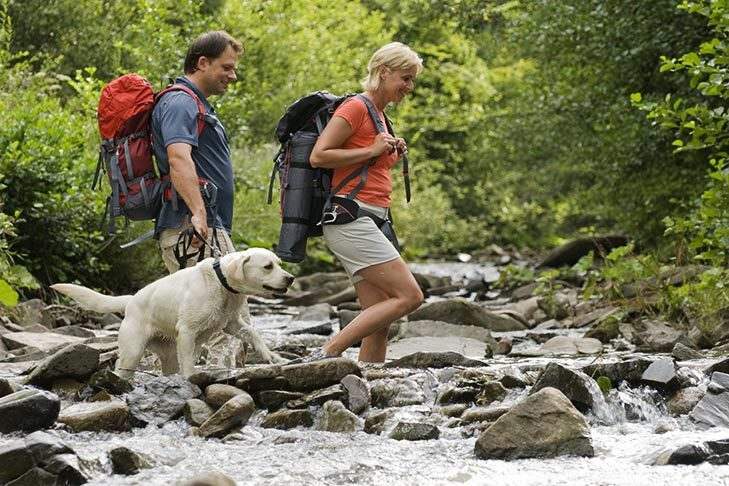
BearWise reports that dogs were involved in more than half of the confrontations between humans and black bears during a recent five-year period. Almost half of the dogs involved were injured or killed, while 62% of their human companions were wounded.
One of the top recommendations for protecting your dog and yourself when hiking in bear country is to always keep your dog on a leash. Dogs that aren’t restrained can chase or corner a bear and may run back to you for protection while being followed by an angry bear. Trying to rescue your dog from a bear is very dangerous.
- Never approach a bear, with or without your dog
- Use a non-retractable leash and prevent your dog from lunging at the bear
- Carry a whistle and bear spray
- To avoid surprise meetups, make noise when you hike in areas with dense vegetation or poor sight lines, and be aware of what’s behind you. Also, avoid walking at dawn, dusk, or in the dark.
- Stay alert to the sounds of breaking branches, and don’t hike while using earbuds
- When you’re camping, remember to keep your dog’s (and your) food and dishes out of the tent and in a bear-proof container
Prepare for Surprise Visits at Home

When I asked a wildlife expert from the Maryland Department of Resources why I saw a bear in my backyard for the first time after almost 30 years living here, she said that as residential and commercial areas expand, we shouldn’t be surprised to see bears crossing through our suburban neighborhoods more and more often.
Wildlife experts recommend taking these precautions to protect your dog at home:
- Feed your dog inside the house, and don’t leave dog food, dishes, or treats in your yard
- Don’t leave garbage or greasy barbecue grills outside, and never put meat in your composting bin
- Stop using bird feeders during spring, summer, and fall
- Keep the gates to your fence closed
- Trim large shrubs
- If you have fruit trees, pick the fruit as soon as it ripens
- Make dog doors small enough that cubs can’t get through, and open them only into enclosed outside areas
- Check your yard before you let your dog outside during the seasons and times of day when bears are on the move
Dogs and People and Bears, Oh My!
Sometimes you may be as cautious as possible, and you and your dog will still meet up with a bear. Here’s what bear experts recommend you do:
- Try to safely move off the trail to let the bear walk by. Don’t stop to take pictures, and if your dog is on a leash, keep them close to prevent them from lunging at the bear. Use a “quiet” command to stop your dog from barking, if possible.
- If the bear is cornered, slowly back away, so it has room to flee. Be careful not to move between a mother bear and her cubs. If the bear doesn’t leave, try talking calmly and slowly waving your arms, but avoid direct eye contact.
- Keep your bear spray ready in case the bear comes closer or follows you. Once you and your dog are safely away, report the encounter to a park ranger or local wildlife organization.
This article is intended solely as general guidance, and does not constitute health or other professional advice. Individual situations and applicable laws vary by jurisdiction, and you are encouraged to obtain appropriate advice from qualified professionals in the applicable jurisdictions. We make no representations or warranties concerning any course of action taken by any person following or otherwise using the information offered or provided in this article, including any such information associated with and provided in connection with third-party products, and we will not be liable for any direct, indirect, consequential, special, exemplary or other damages that may result, including but not limited to economic loss, injury, illness or death.