Five scent-detection dogs are helping researchers identify a unique odor signature linked to hemangiosarcoma. These dogs are part of a study at the Pennsylvania School of Veterinary Medicine to identify the deadly canine cancer. Backed in part by the AKC Canine Health Foundation, the study found that trained dogs could distinguish blood serum samples from dogs with hemangiosarcoma with 70% accuracy. This discovery is a promising step toward future screening tools that could help detect the disease in dogs earlier.
In This Article
Dogs Helping Advance Cancer Detection
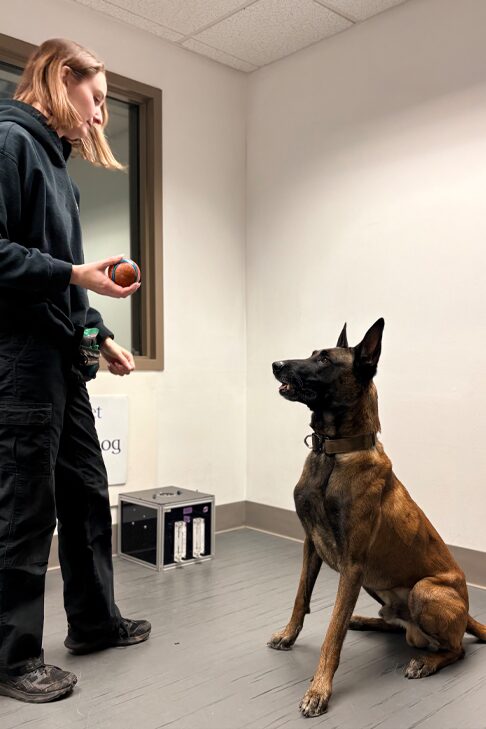
These five dogs, “Churro,” “Penny,” “Luna,” “Vaulk,” and “Bonnie” are helping researchers discover the scent of hemangiosarcoma. Dogs’ noses are incredibly sensitive: at least 100,000 times more sensitive than ours. This means that they can smell things that we don’t even realize have smells. This includes diseases, like hemangiosarcoma. This aggressive blood vessel cancer can strike dogs suddenly and often goes undetected until it reaches an advanced stage.
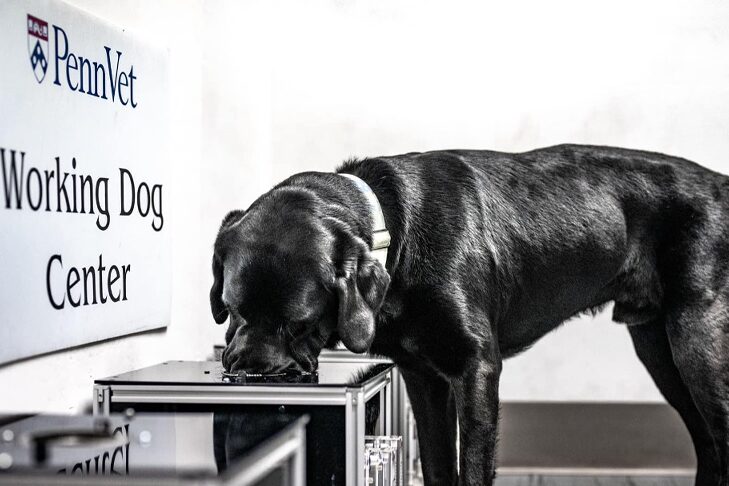
The scent detection dogs worked at the Penn Vet Working Dog Center at the University of Pennsylvania School of Veterinary Medicine. The study was led by Dr. Cynthia M. Otto, DVM, PhD, DACVECC, DACVSMR, who is the Center’s executive director.
Dr. Otto and her team confirmed that hemangiosarcoma produces this detectable odor. They tested it directly against blood serum samples from dogs with hemangiosarcoma, with 70% accuracy. Researchers now hope to build on these findings. The hope is to develop a machine-based screening tool or diagnostic test to detect hemangiosarcoma earlier.
The research was also funded in part by different breed clubs. The Golden Retriever Foundation, Irish Setter Club of America Foundation, Labrador Retriever Club, Scottish Terrier Club of America, Vizsla Club of America Welfare Foundation, and the American German Shepherd Charitable Foundation all helped support.
“What’s exciting about this research is that it’s the first study about dogs helping other dogs,” says Clara Wilson, a postdoctoral research fellow at Penn Vet’s Working Dog Center. “Until now, dogs haven’t been trained to sniff out diseases in other dogs.”
Why Hemangiosarcoma Is So Difficult to Detect
Several institutions, including Cornell’s Coonrod Lab, the Tufts Cummings School, and the University of Minnesota College of Veterinary Medicine, are studying hemangiosarcoma. However, there are no diagnostic tools, preventative measures, or screening tests so far capable of detecting the disease hemangiosarcoma in its earliest stages.
Imaging techniques such as X-rays and ultrasounds can identify masses and help determine their size. But they can’t confirm whether the mass is hemangiosarcoma.
Finding hemangiosarcoma earlier could help extend a dog’s life. It could also improve their quality of life. Unfortunately, many dogs are diagnosed only after the disease has progressed to later stages. At this point, there are usually few treatment options left.
What Is Hemangiosarcoma?
Hemangiosarcoma is an aggressive cancer that develops in cells lining blood vessels. It spreads rapidly throughout the body and often produces few or no signs until late in the disease process.
The cancer commonly affects the spleen, heart, skin, and tissues just beneath the skin. Tumors that form in the spleen can grow large and rupture, while tumors in the heart may cause fluid accumulation that can lead to collapse. Skin hemangiosarcoma is generally less likely to spread than forms found in the spleen or heart.
Although less common, hemangiosarcoma can also appear in the liver, lungs, kidneys, and bone marrow.
The disease is responsible for about 300,000 dog deaths in the United States. It represents about 5% to 7% of the roughly 6 million new canine cancers cases every year.
Any dog can develop hemangiosarcoma, regardless of breed or sex. However, older, large, deep-chested breeds like Golden Retrievers, Portuguese Water Dogs, Boxers, and German Shepherd Dogs are considered at higher risk.
How Dogs Can Detect Disease Through Scent
Teaching dogs to sniff out human disease isn’t a new idea. The Penn Vet Working Dog Center has worked with medical detection dogs for more than a decade. They investigate whether dogs can identify samples from COVID-19 patients, and detect early signs of ovarian cancer, bacterial infections, and diabetes.
Dogs are uniquely suited to this work because they have up to 300 million scent receptors. Their sense of smell is estimated to be 10,000 to 100,000 times sharper than a human’s. Beyond medical detection, these talented dogs also help with law enforcement, security, search and rescue, tracking endangered species, and finding hidden pests.
Dr. Otto and her colleagues wanted to determine if the trained dogs could identify hemangiosarcoma by its scent pattern.
“All odors contain volatile organic compounds (VOCs) that dissipate and evaporate into the air that people and dogs smell,” Wilson says. “Trained dogs can detect the subtle VOCs at lower levels than people can.”
Working the Sniff System
Dogs need to distinguish hemangiosarcoma from odors they had previously learned to recognize. So dogs that can recognize human ovarian cancer and pancreatic cancer samples need to be able to tell them apart. To do this, they use specialized devices called olfactometers.
Olfactometers deliver carefully controlled amounts of clean, filtered air mixed with measured amounts of odor concentrations from the hemangiosarcoma samples.
“We’re looking for the exact smells the dogs could pick up from the volatile organic compounds,” Wilson says. “While clove, for example, will always have the same scent, cancer doesn’t have that same odor profile as it’s more complex.”
Testing the Olfactometers
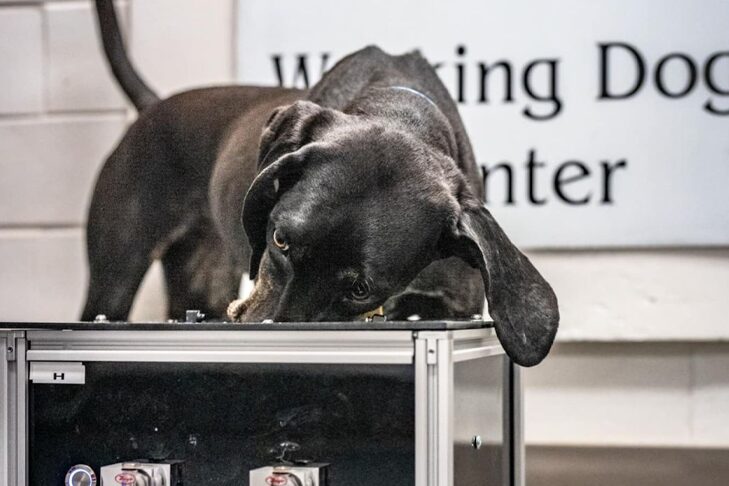
Every dog with hemangiosarcoma will smell differently than another dog, but the team thinks there’s a common thread.
“We can’t give our trained dogs a pure cancer smell to find,” Wilson says. “We have to keep showing them different samples and they have to find the common one.”
Each dog evaluated 12 sample sets over seven trials. During testing, one box at a time released a scent sample, while a red laser beam shows up across the top.
Each trial follows a set process:
- The dog has 90 seconds to check all three boxes. They resemble scent-work boxes with a Mason jar-style hole in the top.
- When the dog identifies a sample, they freeze with their nose on the jar’s opening.
- The dog must hold that position for 2.5-3 seconds.
- If the sample is correct, the dog hears a tone
“This lets the dog know to go to its owner who gives them a treat,” Wilson says. “Our dogs are the gold standard because they have this amazing biology to smell and detect odors at low levels and the brain to synthesize that information.”
The Fabulous Five
Dogs selected for the program undergo extensive training before participating in research.
“It usually takes several months to train a dog how to sniff odors emanating from the olfactometers in this program,” Wilson says.
Seven dogs initially entered the training, but only five completed the program. A Labrador Retriever with experience in detecting explosives couldn’t adjust to the training requirements, while a German Shepherd Dog, was physically unable to participate.
The five bio-detection dogs entered the study with varying levels of experience.
Churro the Belgian Malinois
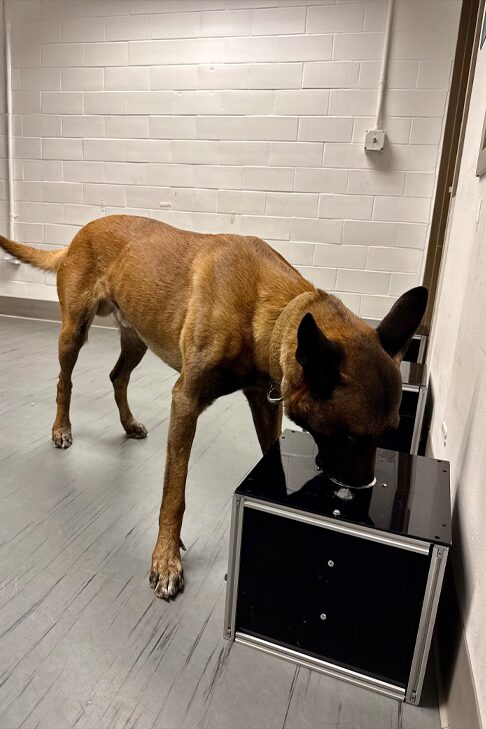
“Churro,” a 5-year-old Belgian Malinois, is also a law enforcement K9 trained to detect explosives. He and his owner, Robert T. Dougherty, Jr., work detection at large outdoor sporting events and concerts.
“He’s very trainable and a social dog and lets Wilson handle him when working at the Center once or twice a week,” says Dougherty.
Bonnie
Bonnie and her owner, Patricia Raine, were participating in AKC Scent Work and agility 10 years ago when Raine’s husband, Tony Michels, heard about a scent-detection program at the Working Dog Center. They were looking for dogs, and they thought of Bonnie.
“Bonnie has a good work ethic and is very focused,” says Raine. “It helps that she’s a food hound and will do anything for string cheese.”
They work twice a week for 30 minutes at the Center.
“Now 13 years old, it’s Bonnie’s favorite thing to do, and we’re doing it for enrichment and to do something worthwhile,” Raine says.
A Mixed-Breed, Collie, and Labrador Retriever
Three other dogs also contributed to the study: Penny, a 4-year-old mixed breed, Luna, a 7-year-old Collie, and Vaulk, a 4-year-old Labrador Retriever.
“The Working Dog Center is amazing,” says Churro’s owner, Robert T. Dougherty, Jr. “We’re participating in research that can help other dogs somewhere down the road.”
Key Takeaways
- Researchers found that trained scent-detection dogs could identify blood serum samples from dogs with hemangiosarcoma with 70% accuracy.
- Hemangiosarcoma is an aggressive blood vessel cancer that is often diagnosed only after it has advanced.
- Scientists believe the disease produces a unique odor signature made up of volatile organic compounds.
- The long-term goal is to develop a screening tool or diagnostic test that could help detect HSA earlier.
- Five specially trained dogs, Churro, Penny, Luna, Vaulk, and Bonnie, participated in the research.
Frequently Asked Questions
-
Can dogs really detect hemangiosarcoma in other dogs?
+
Yes. In this study, trained scent-detection dogs identified blood serum samples from dogs with hemangiosarcoma with 70% accuracy, demonstrating that the disease appears to produce a detectable odor signature.
-
Why is early detection of hemangiosarcoma important?
+
Hemangiosarcoma often causes few symptoms until it reaches an advanced stage. Earlier detection could improve treatment opportunities, quality of life, and survival time for affected dogs.
-
What makes dogs good disease detectors?
+
Dogs have up to 300 million scent receptors and can detect extremely small concentrations of odor-producing compounds that humans cannot perceive.
-
Is there currently a screening test for hemangiosarcoma?
+
No. Researchers are actively studying the disease, but there is currently no widely available screening test or diagnostic tool that can reliably detect hemangiosarcoma in its earliest stages.
-
Could this research lead to a future diagnostic test?
+
That is the goal. Researchers hope the odor signatures identified by trained dogs can eventually be translated into a machine-based screening tool or diagnostic test for canine hemangiosarcoma.
This article is intended solely as general guidance, and does not constitute health or other professional advice. Individual situations and applicable laws vary by jurisdiction, and you are encouraged to obtain appropriate advice from qualified professionals in the applicable jurisdictions. We make no representations or warranties concerning any course of action taken by any person following or otherwise using the information offered or provided in this article, including any such information associated with and provided in connection with third-party products, and we will not be liable for any direct, indirect, consequential, special, exemplary or other damages that may result, including but not limited to economic loss, injury, illness or death.