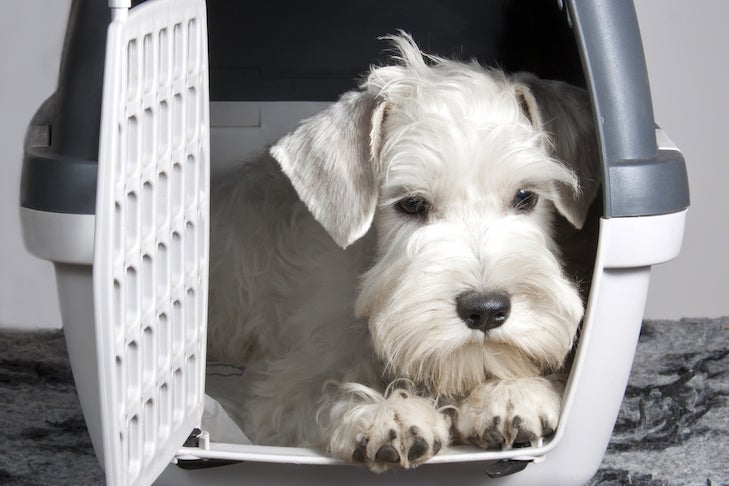
In today’s ever-connected world, your puppies’ families aren’t always the neighbors across town who found you in the local paper. Sometimes, prospective buyers will need to fly their new puppy home. To help them prepare, here are some useful tips and a travel checklist you can share with your puppy buyers.
What Breeders Can Do
If you don’t have an airplane travel bag on hand, you can ask the puppy’s new family to ship you the one they are going to be taking the puppy home in so the puppy can begin getting familiar with it. Practice having the puppy go in and out of the bag, rewarding with treats, and encourage them to nap inside it. Be sure to include a blanket or toy that carries the scent of the mother and litter to help comfort the puppy during travel. You can also place the travel crate on top of a running dryer to simulate the noise and movement of an airplane, but always under supervision.
Another helpful thing you could do is put together a small travel kit for the puppy parents or send them a checklist, so they know exactly what to bring and what to expect. On go-home day, try to time the puppy’s last meal and potty break so they’ve eaten and pooped before heading to the airport. Make sure to include a few small snacks the puppy is used to, so the new owners can reward and redirect as needed at the airport and the puppy doesn’t become overly hungry.
Travel List:
- Airline Approved Crate
- Slip Lead
- Small battery fan (air circulation and noise)
- Blanket to cover crate
- Pee Pads (for lining the bottom of the crate and in airport bathrooms)
- Poop Bags
- Wipes for puppy
- Paper towels/cleaning wipes
- Large Ziplocs (to put mid-flight messes in an airlocked container)
- Chews, multiple options to switch out
- Non-squeaky toy
- Collapsible bowl
- Empty Bottle to refill when past security
Tips for Puppy Parents
Traveling with a puppy through an airport can feel overwhelming, especially if the puppy is still very young or not fully vaccinated. Preparing ahead of time and understanding what to expect can make the experience smoother for both you and your pet. The first and most important step is to check the specific regulations of the airline you are flying with. Each airline has its own requirements for pets in the cabin, including carrier dimensions, weight limits, paperwork, and fees. Knowing these details early will prevent last-minute complications at check-in.
Once you arrive at the airport and head toward security, keep your puppy inside the crate until TSA officers tell you otherwise. When it is your turn, they will instruct you to take the puppy out of the carrier and hold it as you walk through the metal detector. Your hands will likely be swabbed for security screening while you continue to hold the puppy. As soon as the process is complete, place your puppy back into the crate to keep it safe and contained during the busy security area.
If your puppy needs a bathroom break, try to find a family restroom or a standard restroom stall where the dividers reach all the way to the floor. These spaces offer privacy and prevent your puppy from seeing or interacting with other animals or people. Line the floor generously with potty pads before letting the puppy out. It is important to avoid airport pet relief areas when traveling with an under-vaccinated puppy, as these spots are high-traffic zones for many different animals and can carry a higher risk of disease exposure.
During layovers, keep your puppy in the carrier as much as possible. This helps limit stimulation, exposure, and risk, while also complying with most airport rules requiring pets to remain crated unless in designated pet areas. Try to choose a quiet corner of the terminal where your puppy can rest, offering a small amount of water or a brief, quiet moment of reassurance through the mesh of the carrier is usually enough to keep the puppy calm.
With planning, patience, and a clear understanding of what to expect, navigating airport travel with a young puppy becomes much more manageable.